

Christine Hernandez
Early childhood educator, writer, and mother. Your friendly neighborhood guide to all things parenting.
Being a baby is tough. Their little brains are developing so rapidly and they can understand much more than they can express. This inevitably leads to frustration because they know what they want but can’t express it in a way that their caregiver can understand. Luckily, teaching sign language to infants and toddlers may help cut down on tantrums and give pre-verbal children an effective way to communicate.
If you are curious about using sign language with your child, here’s what you need to know.
- What is Baby Sign Language plus a bit of history of the development of the language.
- How You and Your Baby Can Benefit From Sign Language
- When Can You Start Teaching Your Baby Sign Language?
- How do I get started?
- Tips for success
- Top 12 signs to teach your baby
- Ways to Maintain Sign Language Fluency
What is Baby Sign Language?
Baby Sign Language is a simplified adaptation of traditional Sign Language, tailored to the communication needs of babies and toddlers. It involves using gestures and signs to communicate needs, desires, and observations before the development of vocal speech. The concept is rooted in the idea that babies inherently have the desire and capacity to communicate from a very young age, but lack the physical and developmental ability to form spoken words.
The history of Baby Sign Language can be traced back to research and observations made in the late 20th century. Studies suggested that infants who were taught sign language could communicate basic needs and emotions before they were able to speak, potentially reducing frustration for both the child and parents. This concept gained popularity among parents and educators as a tool to enhance early communication.
One fundamental aspect of teaching Baby Sign Language is ensuring that the signs are simple enough for a baby to mimic. For example, the sign for "more" is made by bunching your hands so that your fingers touch your thumb and then tapping your hands together. This gesture is easy for small hands to attempt and is a powerful tool for a baby to express a desire for more of something, such as food or play.
How You and Your Baby Can Benefit From Sign Language
Developmental
Your child’s brain is hard-wired to learn multiple languages. In fact, long before a baby is able to speak, they are able to distinguish their home language from other languages. Introducing your infant or toddler to sign language will allow them to flex their communication muscles as well as their actual muscles. Since many signs require children to cross the midline, the invisible line between the left and right sides of their bodies, sign language also fosters the development of key motor skills needed for future learning.
Social
If you’ve ever watched a young child struggle to communicate their needs by pointing or grunting, you can imagine how frustrating it must be for them. By learning sign language, children are better able to communicate with their families and caregivers. Parents may understand a toddler’s made-up language of grunts and cries, but by equipping them with sign language they are able to express themselves outside of the home as well. Additionally, some children with or without special needs may take longer to develop speech and sign language can be a great way for them to express themselves.
Parent-Child Relationship
Not being able to understand what your child wants can be frustrating for a parent. If your child is able to sign “water” instead of crying or whining, you may feel more confident in your ability to meet their needs. When your child feels understood, they are more likely to try their hand at communicating more often. Fewer tantrums = less stress for the whole family. Before you know it, you will be having mini-conversations with your baby or toddler via sign language.
When Can You Start Teaching Your Baby Sign Language?
You can start introducing sign language to your baby anywhere between six to eight months or when they are able to sustain eye contact for more than a few seconds. Start with words that can be easily connected to an object like “milk” or “ball”. Once your baby is looking at you, say the word and make the sign, then give them the object. Continue repeating the signs and encourage other adults in your child’s life to practice with them. Eventually, your child will begin to mimic or sign on their own and then you can move on to new words. If you missed the six to eight month time period you can start at any point. It is never too late for a child to learn sign language.
How do I get started?
First, you're going to want to choose a sign to start with. For many families, a meal-time-related sign makes the most sense, because their baby is seated and engaged, making it the perfect time to learn something new.
If you were going with "more" as your first sign, midway through the meal, or whenever your baby looks like they want more, you would say, "oh, you want more?!" Emphasize the word "more" and sign as you're saying it. Do this for a few days, making the connection between the spoken word and the sign.
After a week or so, depending on your baby's age you can start to prompt them to sign back to you. When it comes to that time during the meal when you'd normally say and sign more, hold the food item and ask "do you want more, can you show me, "more"?" Give your child a moment or two to respond. If they don't, it's okay! Some babies catch on quickly while others take a bit longer to start signing on their own.
Once your child has mastered their first sign, you can move on to another one. Go at your child's pace, if you feel like they can handle learning two signs at a time— try it!
Tips for success
Although every child learns at their own pace, there are some things you can do to set yourself up for success when it comes to teaching your baby sign language.
- If you are starting at mealtime, you may want to wait until your child has started eating so they are not too hungry or cranky to absorb what you're trying to teach them.
- Get everyone on board. The more people in your child's life that practice signing with them, the more likely they are to absorb it.
- Keep it low-key and fun. Older babies and toddlers can start to sense when it's something we want them to do, and may refuse to assert their independence.
Top 12 signs to teach your baby
You'll want to use signs that your baby is motivated to use, and usually, that means they'll get something in exchange for using them. Words that can be used during meal times or play times, are generally the most successful.
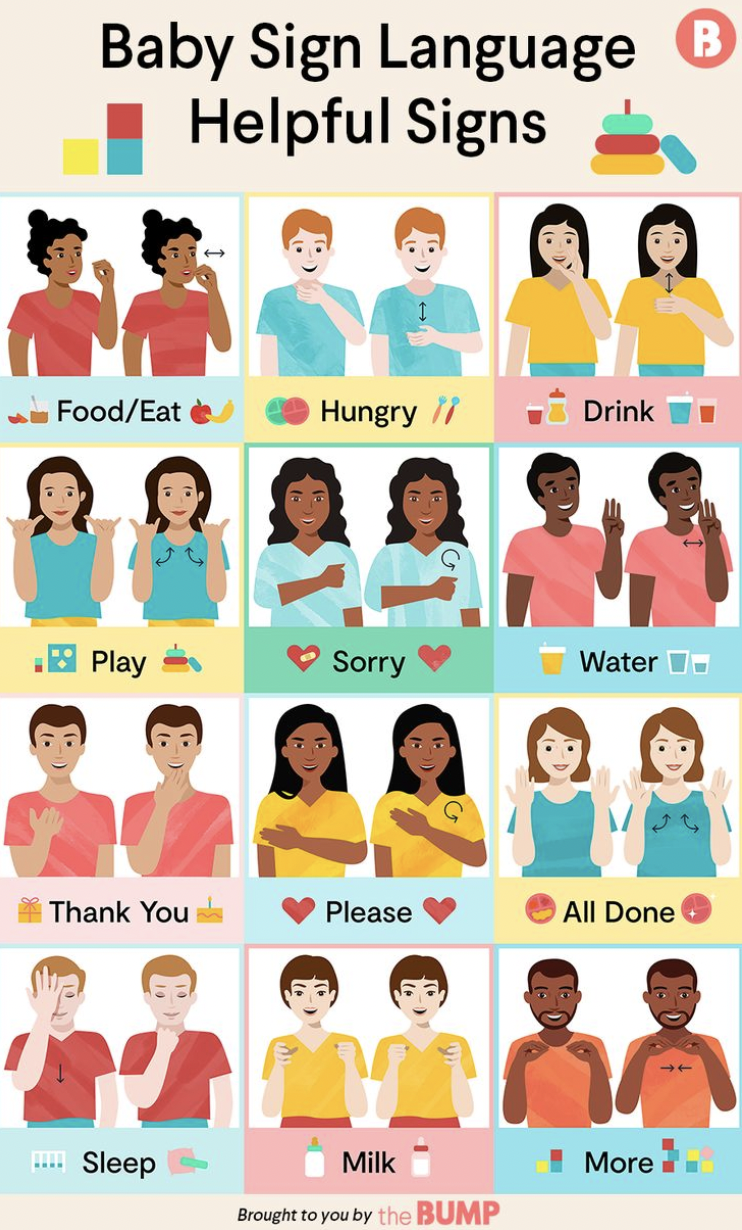
Food/Eat:
Make a flat hand and tap your mouth once or twice.
Hungry:
Rub your stomach with a circular motion.
Drink
Mimic holding a cup and tilt it into your mouth.
Play
With both hands, extend your pinky and thumb while keeping the other fingers closed, and twist your wrists back and forth.
Sorry
Form a fist with one hand and move it in a circular motion across your chest.
Water
Tap your index finger on your chin.
Thank You
Touch your chin with the fingers of one hand and bring your hand forward and down.
Please
With your hand flat, fingers together and thumb extended, make a circular motion on your chest.
All Done
Hold your hands up, palms facing you, and twist your wrists to flip your palms facing out.
Sleep
Open your hand over your face and then close it as you bring your hand down to your chin, as if indicating sleep.
Milk
Open and close your hand as if you were milking a cow.
More
Make an 'O' shape with each hand, then bring your fingertips together repeatedly.Ways to Maintain Sign Language Fluency
The more practice your child has with sign language, the better. Be sure that everyone in your child’s life is aware of what signs your child already knows so they can practice with them. If your child attends daycare, talk to your provider about incorporating sign language into your child’s day. Also, once your child is speaking, you don’t need to abandon the use of sign language. In fact, knowing two languages (either spoken or signed) has been known to boost cognitive functioning and even increase IQ.


