

Christine Hernandez
Early childhood educator, writer, and mother. Your friendly neighborhood guide to all things parenting.
For parents with young children, finding high-quality, affordable childcare can be daunting. Many parents struggle to find childcare within their budget and desired location, but for families living in “child care deserts,” it may be difficult to find any childcare at all.
What is a childcare desert?
Although the term “childcare desert” is a relatively new one, it is beginning to make its way into the political conversation. Borrowed from the term “food desert”, which describes an area without proximity to fresh, affordable, and healthy food options, “childcare desert” is based on a similar concept.
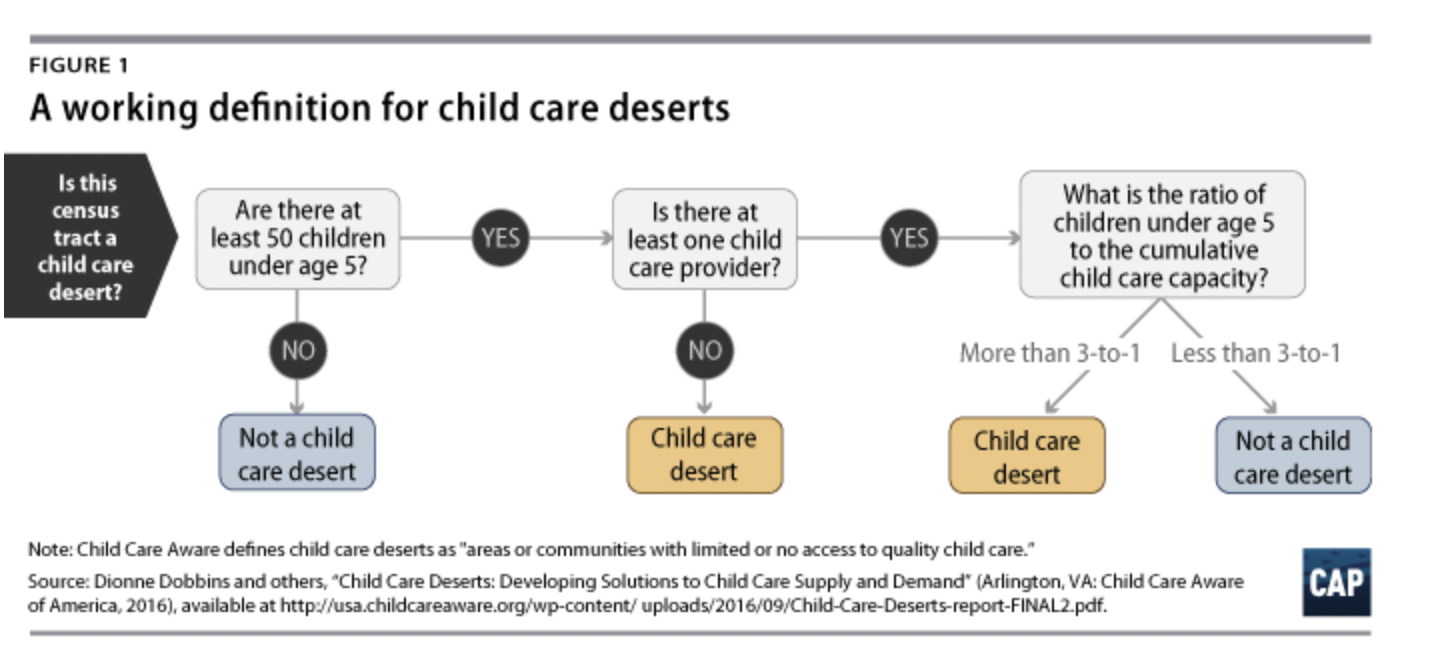
A child care desert, as defined by the Center for American Progress, is an area with at least 30 children under the age of 5 and either no child care providers at all or so few that there are more than three times as many children under the age of 5 as there are childcare spots available.
Where are childcare deserts located?
Childcare deserts are disproportionately located in rural areas or areas with higher concentrations of families living at or below the poverty line. Affordability is a well-documented barrier for many families, with full-time center-based childcare costing upwards of $18,000 a year. Still, the cost of care is not the only issue at play. The real problem is whether there are enough childcare slots available for the families who need them.
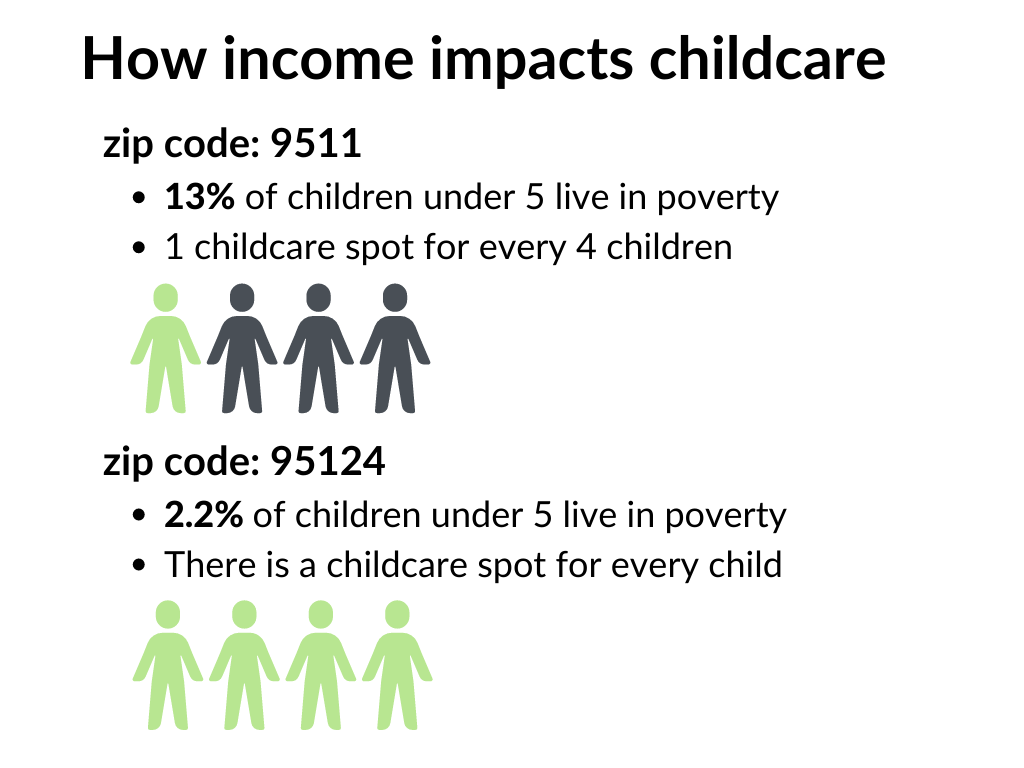
San Jose, California is an example of an area where the saturation of childcare providers can vary depending on the average income of the families in the neighborhood. For example, an estimated 4,463 children live in zip code 95111, with 13% of those children living under the poverty line. When we analyzed data from Winnie, a marketplace that helps parents find high-quality local childcare, we found only enough spots for 1/4 of the children who live in the area.
Drive five minutes down the road to zip code 95121, where 11% of the children under 5 are living under the poverty line and you’ll find enough licensed childcare slots for nearly half of them. There are 899 childcare slots for the 1786 children under the age of five living there.
Meanwhile, fifteen minutes away, in zip code 95124, where only 2.2% of the children under the age of 5 live under the poverty line, there are 4,360 licensed childcare slots for the 3129 children under five living there. This means that there are enough childcare slots for every child who lives here, and some may even be able to choose between more than one program.
What can be done about childcare deserts?
Although childcare deserts have been an issue since before the COVID-19 pandemic, closures and relocations have made the problem worse. Governments are finally seeing that parents need to have access to safe and affordable childcare for an economy to thrive. More companies are offering flexible working hours or on-site childcare, which may provide temporary solutions for families. At Winnie, our goal is to help parents find high-quality, affordable childcare that meets the needs of their family, while working toward making childcare more accessible for everyone.


