
-1.jpg?height=100&name=Image%20from%20iOS%20(2)-1.jpg)
Winnie
Navigating the educational landscape for children with disabilities often involves understanding two pivotal support mechanisms: the 504 Plan and the Individualized Education Program (IEP). Both are designed to ensure students receive the assistance they need, but they differ in scope, eligibility, and implementation.
What is an IEP?
An IEP, or Individualized Education Program, is a detailed plan that provides special education services and supports, including tailored instruction and goals, for students whose disabilities affect their learning. It’s governed by a federal education law.
What is a 504 plan?
A 504 Plan is a plan that ensures students with disabilities can access the general education curriculum through accommodations, like extra time on tests or modified assignments. It’s based on a civil rights law to prevent discrimination.
Who Creates Each Plan?
The creation of an IEP involves a formal, multidisciplinary team with strict legal requirements, including the student’s parents, at least one general education teacher, at least one special education teacher, a school psychologist or other specialist, and a district representative with authority over special education services. This team must be present for meetings, with few exceptions, and the process includes annual reviews and reevaluations every three years to ensure the plan meets the student’s evolving needs.
For a 504 Plan, the team is less formally structured, typically comprising the student’s parents, general and special education teachers, and school administrators, with rules about composition being less specific. The development process is less rigorous, and while reviews are generally annual, reevaluations occur every three years or as needed, with state-specific variations.
What Each Plan Includes
An IEP includes the student’s current performance, annual goals, special education services, accommodations, and how progress is tracked, reviewed at least yearly. A 504 Plan outlines specific accommodations, like seating arrangements or breaks, and may not always be a written document, with less rigid review processes.
Who Each Plan is Designed For
IEPs are for K-12 students needing specialized instruction due to disabilities affecting learning, like autism or learning disabilities. 504 Plans are for students with disabilities needing accommodations to access general education, applicable from K-12 through college and employment.
Differences and Similarities
Both plans aim to support students with disabilities for equal education access, but differ in legal basis (IDEA for IEPs, Rehabilitation Act for 504 Plans), services (special education vs. accommodations), and process formality. Typically, if a student qualifies for an IEP, a separate 504 Plan isn’t needed, though rare cases exist, like for temporary medical conditions. 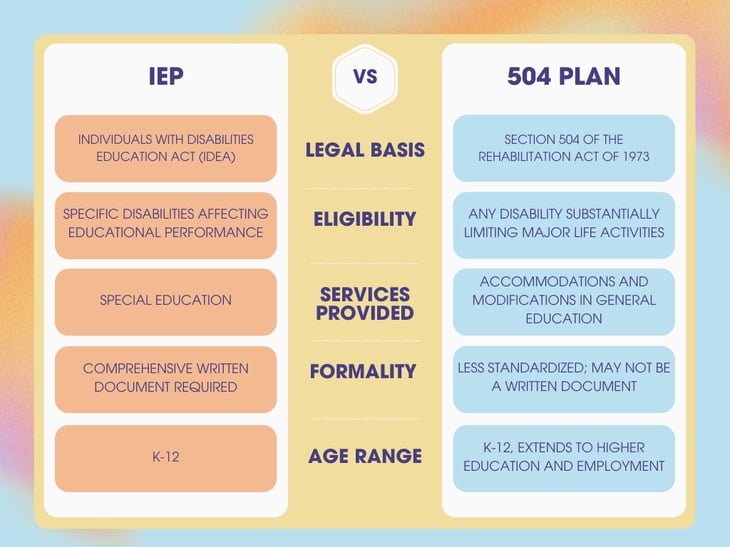
The overarching goal of both IEPs and 504 Plans is to enable students with disabilities to receive an education that meets their unique needs, fostering academic, social, and emotional growth. IEPs achieve this through specialized instruction and services, ensuring students can make progress in their least restrictive environment, while 504 Plans ensure access to the general curriculum through accommodations, promoting inclusivity across various educational and life stages.
Parents and educators should consider the student’s specific needs, consulting with school teams to determine the most appropriate plan, and be aware of their rights, such as requesting evaluations or resolving disputes through mediation or other legal avenues.


