

Christine Hernandez
Early childhood educator, writer, and mother. Your friendly neighborhood guide to all things parenting.
When searching for childcare, safety is at the top of most parents' priority list. One way to ensure a program you are looking at meets your safety standards is by viewing the program's licensing information. Many parents don't realize that a childcare program's license history, including any violations or citations, is public information and can be found on the program's Winnie listing. From why it's essential to what to look for, we're breaking down everything parents need to know about childcare licensing.
- Why would I choose a licensed provider over one that isn't licensed?
- How does a daycare provider become licensed?
- Are some daycares exempt from licensing?
- What is the difference between licensing and accreditation?
- How can I find out if my daycare is licensed?
Why would I choose a licensed provider over one that isn't licensed?
Having a childcare license doesn't guarantee a program is of high quality or that it's the best option for your family. Still, it does mean that there are standards and guidelines in place that the provider must comply with to obtain and remain licensed. Although each state's licensing requirements are different, most states prioritize safety, documentation, and staffing. For example, state licensing requirements generally dictate the staff-to-child ratio or how many children are allowed to be in care at one time.
A licensed provider may only have a certain number of children present each day and needs to provide adequate staffing to care for those children. However, an unlicensed provider may not have any oversight on how many children they can safely care for or how many staff members are required.
Licensing requirements also address safety guidelines for the home or center, the training or education required for staffing, and the nutrition of the food served. When it comes to caring for children, the more safety precautions and procedures in place, the better, and a licensed provider is held accountable to their state's requirements.
How does a daycare provider become licensed?
When applying for a childcare license, a provider must provide the following documentation in addition to an inspection of the center or home:
- Health and safety procedures they'll follow to help protect your child from injury and illness
- How many staff members will be present and how many children cared for
- Background checks of adults and caregivers
- Safe sleep practices for infants and toddlers
- Education and ongoing required training for caregivers
- Plans for program management and oversight, record-keeping, etc..
Are some daycares exempt from licensing?
There are some situations where childcare programs are not required to be licensed by the state. The specifics vary from state to state, but typically a provider may be able to operate without a license in the following circumstances:
- Only a few children are being cared for at a time. In most states, a person can care for 1-2 children in addition to their own child without needing a license.
- If a church or religious institution operates the program, they may not be required to have a license from the state.
- If the program is a before or after school program in a school building, or a Universal Pre-K program located in a district, they are not required to be licensed childcare facilities and are typically regulated by the Department of Education instead.
.png?width=1080&name=Child%20Care%20Centers%20usually%20are%20required%20to%20be%20licensed.%20However%2c%20there%20are%20some%20exceptions%20to%20this.%20In%20some%20states%2c%20programs%20with%20a%20religious%20affiliation%20may%20not%20be%20required%20to%20have%20a%20license.%20In-home%20daycares%20may%20or%20(1).png)
What is the difference between licensing and accreditation?
Some childcare providers go above and beyond the licensing requirements and seek additional recognition from an accreditation agency. The National Association for the Education of Young Children (NAEYC) and the National Association for Family Child Care (NAFCC) are two of the more common agencies providers seek accreditation from. The guidelines for accreditation go even further than the physical safety guidelines required for certification and dive deeper into how the program meets the social-emotional needs of children, how child progress is documented, and the quality of the curriculum or learning environment.
How can I find out if my daycare is licensed?
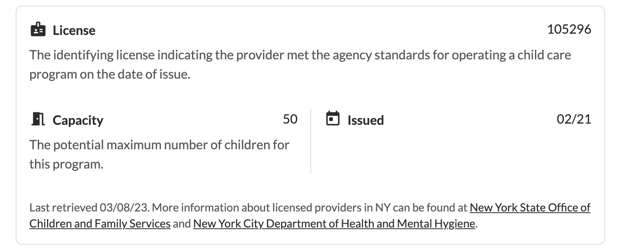
You can search for licensed childcare providers using Winnie. Each provider’s listing contains all of their licensing information and a link to check out their recent inspections and any violations found. Reviewing a provider's license history is one way to help parents make empowered, informed decisions about who cares for their children.
Besides viewing a programs inspection history and licensing information you’ll want to:
Tour the Facility or Home
Visit the facility or home to ensure it meets your standards for cleanliness and safety. Pay attention to whether the caregivers and children appear happy and engaged.
Read Reviews
Look for reviews from other parents. You can find these on the provider’s Winnie listing.
Ask Questions
Don’t hesitate to ask as many questions as you need. There’s no such thing as a “stupid” question when evaluating a childcare provider. If it’s on your mind, chances are other parents have wondered the same thing.
Trust Your Instincts
Go with your gut. You’ll know when a program feels right for your child.
To search for licensed childcare providers, summer care, and school-age childcare in your area head to Winnie.


