

Tia Sauls
Tia Sauls is an early education specialist who helps families and educators navigate the child care, early education, and K–12 landscapes.
Choosing a childcare provider goes beyond finding a program that fits your schedule and budget. More importantly, parents want to know that their children will be safe, well cared for, and in an environment that meets important health and safety standards.
That's where childcare inspection reports come in. These reports give parents an objective look at how a childcare program operates behind the scenes and whether it is meeting state licensing requirements.
At first glance these reports can be difficult to understand as they are filled with technical language. But don’t worry, you don’t need to understand every regulation to use them effectively.
In this guide, we’ll break down how to read a childcare inspection report, and explain everything that matters so you can fully understand it before making a decision.
What Is a Childcare Inspection Report?
Simply put, a childcare inspection report is an official document created by a state or local licensing authority after inspecting a childcare program.
These inspections are done to ensure that childcare businesses meet health, safety, staffing and operational requirements. While this varies by state, providers may have routine inspections, complaint investigations, follow-up visits or unannounced inspections throughout the year.
Type of inspection conducted:
|
Inspection type |
What it means |
|
Routine inspection |
A regularly scheduled inspection required by the state |
|
Complaint inspection |
Conducted after someone reports a concern |
|
Follow-up inspection |
Used to verify previous issues were corrected |
|
Unannounced inspection |
Conducted without prior notice |
How often inspects occur varies by state. Some states conduct inspections annually, and others may do them multiple times a year, especially when a childcare center has complaints against them or has previous violations that require follow-up inspections.
Inspection reports may include a provider's licensing credentials, inspection dates, the number of children in the provider's care at the time of the inspection, any deficiencies identified, and whether those issues were corrected.
For example, you may see:
- License status: Active
- Inspection date: March 10, 2026
- Number of children present: 24 of 30 licensed spaces
- Deficiency: Staff-to-child ratio violation
- Corrective action: Resolved during a follow-up inspection
How to Read a Childcare Inspection Report Step by Step
Childcare inspection reports are filled with lots of information for both parents and providers. Here are a few steps parents can follow to help make reading these reports easier.
Step 1: Review the facility information
Start by reviewing the program's basic information. This will give you context about the provider and the inspection.
Keep an eye on the following information:
|
Information |
Why it matters |
|
Licensed capacity |
Shows the maximum number of children the provider is legally allowed to care for |
|
Number of children present |
Helps identify potential supervision or ratio concerns |
|
Inspection date |
Shows how recent the information is |
|
Inspection type |
Explains why the provider was inspected |
Quick Scenario:
If a provider exceeds their licensed capacity, an inspector will note it in the report as it could potentially be a supervision and safety concern. This is why parents should pay close attention to inspector notes as repeated capacity issues could indicate ongoing supervision challenges.
Step 2: Read the inspector's notes and corrective actions
An inspector’s notes are just as important as the violation. Reading an inspector’s notes can give you more context about the violation. Their notes will explain what happened and when, the severity of the issue and what actions the provider took to address it.
Step 3: Review Corrective Actions Section
How and when a provider addresses the issues identified in their childcare inspection report speaks to how seriously they take the safety of the children in their care. If an issue is identified by an inspector, a provider will be given a timeframe in which to fix it.
In many cases child care providers are expected to fix deficiencies within a specific timeframe. Failure to do so could lead to additional inspections, fines, probationary status, suspension, or even license revocation depending on the severity of the deficiencies and failure to comply.
How to Interpret Childcare Deficiencies
In a childcare inspection report, deficiencies mean a provider didn’t meet the licensing requirement during the inspection. But it's important to note that not all deficiencies carry the same level of concern.
Some states may include a severity level or risk category within the inspection report, and others may only describe the violation itself. If you find a report where the severity rating isn’t available, you could determine whether the deficiencies could directly impact your child’s health, safety or supervision.
Repeated deficiencies are sometimes more concerning than isolated incidents because they speak to ongoing problems rather than one-time mistakes.
Use the table below as a guide when reviewing childcare inspection report deficiencies:
|
If you see... |
What it could mean |
Level of concern |
|
Missing attendance logs |
Administrative issue |
Low |
|
Incomplete staff training |
Operational issue |
Medium |
|
A child left unsupervised |
Safety issue |
High |
What Childcare Violations Should Parents Actually Worry About?
Thinking that a violation immediately means that a childcare program is unsafe is a big misconception. If possible, review several inspection reports instead of the most recent one. This can help you identify recurring issues and whether providers consistently correct deficiencies.
Examples of different types of violations and their severity:
Serious safety violations: These violations put children at immediate risk. This includes unsafe sleep practices, children left unsupervised, hazardous materials within children’s reach and unsafe playground equipment.
Operational violations: These violations may not create immediate danger but should be monitored. This includes incomplete staff training or missing procedures.
Administrative violations: These violations are often paperwork-related and aren't necessarily a sign that a provider is unsafe, but if repeated could cause operational challenges.
How Do Inspection Reports Affect a Childcare License?
Not every violation impacts a provider’s license immediately. In some states, providers are given the opportunity to correct violations before further steps are taken.
However, cases of repeated violations, ongoing safety concerns or failure to correct deficiencies can lead to penalties including suspension, fines and in serious cases, license revocation.
Red Flags Parents Should Look For
Although licensed providers are expected to meet state requirements, you should still review inspection for recurring safety concerns.
Watch for:
- Frequent staff-to-child ratio violations
- Multiple incidents involving child supervision
- Several complaint investigations within a short period
- Repeat safety violations across multiple inspections
- Failure to correct previous deficiencies
It's important to note that some providers may still have active licenses while addressing deficiencies. But repeated serious violations over time may indicate bigger operational or safety concerns that warrant additional questions.
Use Winnie to Research Childcare Programs More Easily
Reviewing childcare inspection reports often requires parents to visit multiple state licensing websites to gather information about a facility.
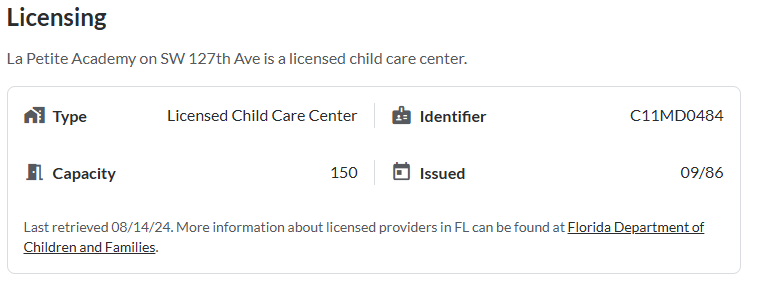
Winnie helps make this research easier by displaying licensing information directly on facility profiles where available. Parents can quickly verify a facility's license status, see whether a facility is licensed, licensed exempt, or subject to different state regulations, and use that information as a starting point for their research.
Winnie also links directly to state licensing databases so parents can review additional information, including inspection reports and a facility's licensing history when available.
This allows parents to verify that a facility is up to date while also giving them access to official state resources for further research.
To continue your research, you can also learn more about daycare licensing for parents, how to look up daycare violations, and childcare safety standards every parent should know before making your final decision.
Final Thoughts
Reading a childcare inspection report doesn’t have to be complicated. Instead, take note of the provider's information, the inspector’s notes, and the corrective actions taken.
It is important to note that not all deficiencies should be judged on the same level. Repeated deficiencies that go uncorrected or require follow-ups say more about a provider and their childcare business than a one-time mistake.


