

Tia Sauls
Tia Sauls is an early education specialist who helps families and educators navigate the child care, early education, and K–12 landscapes.
Learning doesn’t only take place in the classroom. Children can learn in many different settings including outdoors.
Outdoor learning exposes children to hands-on exploration, movement, and nature-based activities. And as a childcare provider, you can create an outdoor learning environment that gives children access to these benefits and strengthen your program’s offering.
You may think that this can be hard to achieve but it doesn’t have to be. Take a look through our guide to setting up outdoor classrooms, whether you have a large playground or a small outdoor area, it can be done.
What Is an Outdoor Classroom?
Much like the name suggests, an outdoor classroom is a learning environment outside of the confines of a traditional classroom. Simply think of an outdoor classroom as an extension of your current classroom. Much like these classrooms are designed to give children opportunities to learn and explore outdoors.
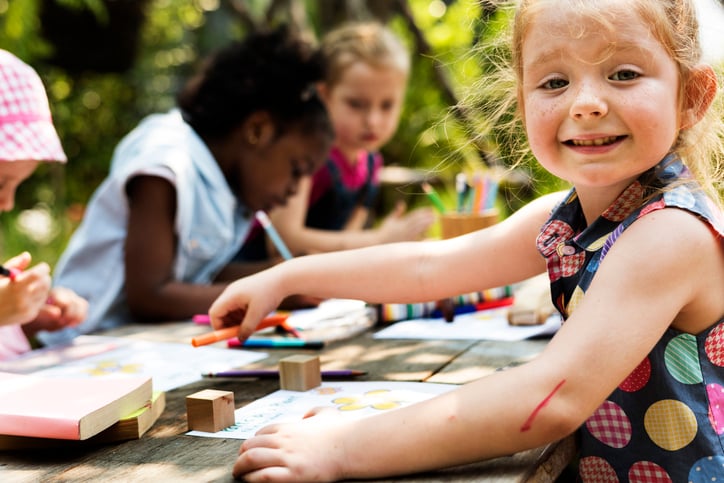
These activities include art projects, sensory activities, gardening, free exploration and small group learning.
Outdoor classrooms expose children to a new learning environment while maintaining the existing curriculum of your program.
Benefits of an Outdoor Classroom
While offering children variety to their daily routine, an outdoor classroom allows children to learn in different ways which can help maintain engagement. It also offers great benefits that can support different areas of a child’s development.
|
Benefit |
How It Supports Children |
|
Increased physical activity |
Promotes moments that can support the development of gross motor skills |
|
More hands-on learning |
Allows children to learn concepts through play |
|
Improved engagement |
Children often remain interested in activities for longer periods |
|
Stronger social skills |
Encourages teamwork and communication |
|
Better problem-solving abilities |
Open-ended activities promote independent thinking |
|
Connection with nature |
Builds environmental awareness from an early age |
Plan How Your Outdoor Classroom Fits Your Program
Before physically setting up your outdoor classroom, you should consider how the outdoor classroom will fit into your current daily schedule and program curriculum.
In order to be different and offer children variety, your outdoor classroom should complement your indoor classroom instead of duplicating it.
|
If your indoor classroom already has... |
Your outdoor classroom could include... |
|
Reading corner |
Storytelling circle |
|
Art center |
Outdoor easels and chalkboards |
|
Science center |
Gardening and nature exploration |
|
Sensory tables |
Water and sand stations |
|
Music center |
Outdoor instruments and movement activities |
Many educational programs including Montessori and Waldorf already emphasize hands-on learning; however, they apply it differently to best suit their teaching philosophies. Taking a look at these approaches can help you determine how outdoor classrooms can fit into your program.
Choose the Right Outdoor Space
The location of your outdoor classroom is very important. Consider an area that children can easily transition to and teachers easily supervise.
It can be beneficial to observe the space at different times of the day to highlight any challenges you may face.
Things to consider include:
- Natural shade
- Proper drainage
- Clear visibility for supervision
- Safe boundaries
- Accessibility for all children
- Close proximity to indoor classrooms
Create Different Learning Zones
Much like a childcare center has different classrooms, your outdoor classrooms can have different learning zones. This allows for more organization and gives children the freedom to move between activities with ease.
Gathering and Storytime Area
A gathering and storytime learning area will be dedicated to activities such as group discussions, storytelling and circle time. For this area, you can include benches, tree stumps, portable whiteboards and rugs.
Sensory Exploration Area
A sensory and nature exploration area will give children the opportunity to learn through sensory experiences. Materials that will support hands-on learning in this space include sensory bins and water tables.
Nature, Science, and Gardening Area
Science doesn’t only take place in a lab. Instead, you can teach it through gardening which will allow children to learn about plant life cycles, weather patterns and will give them responsibility. You can include garden beds, magnifying glasses and planting containers.
Creative Arts Area
An outdoor creative arts area gives children the opportunity to create and express their creativity without worrying about indoor messes or volume levels. To build this space include chalkboards, painting materials, a music station and recycled materials for projects.
Learning zones can also support different teaching approaches. For example, a gardening and storytelling zone may align with Forest School principles, and the storytelling area complements a Waldorf-inspired environment.
Choose Sustainable Outdoor Classroom Materials
Creating or setting up an outdoor learning space doesn’t always require expensive materials to be effective. Simply start with tools that can be used across multiple activities.
Some useful items include:
- Portable whiteboards or chalkboards
- Weather-resistant storage bins
- Tree stumps or benches
- Picnic tables
- Gardening tools
- Waterproof storage box
- Outdoor books and learning materials
Prioritize Safety and Licensing Requirements
The safety and security of the children at your center should always be a priority. And depending on your state, major changes to your outdoor infrastructure may need to comply with childcare licensing requirements.
Tip 1: Review your regulation requirements with your local state licensing office before making permanent changes to your childcare center.
Tip 2: Conduct regular inspections of your outdoor classrooms to ensure materials are in great condition. Monitor allergy risks, sun protection measures, weather conditions, equipment wear and tear, and walking surfaces for hazards.
Get Staff and Families Involved
An outdoor classroom can be a great opportunity for community participation. Staff members, families and even local businesses can contribute ideas and resources.
Create a small committee to help organize activities, gather donations and maintain the space overtime. Children can get involved by assisting with decorating, which can increase their excitement and give them a sense of ownership.
How Winnie Can Help Families Discover Your Program
Outdoor classrooms can be a unique offering which help your program stand out to families when comparing childcare options.
Having a Winnie profile will allow you to highlight your different learning environments, activities and experiences that make your program a great childcare experience. With your Winnie listing, you can also use photos and program descriptions to showcase your outdoor classroom, hands-on learning and nature-based activities.
Outdoor classrooms aren’t meant to replace your existing classrooms. Instead they aim to strengthen the support you are already offering children. Regardless of size, outdoor classrooms can give children new and innovative ways to explore, create, and learn.
This style of teaching doesn’t require a full program renovation. Instead, you can start by adapting your current outdoor space, incorporating children’s interests and using available resources and materials.


