

Christine Hernandez
Early childhood educator, writer, and mother. Your friendly neighborhood guide to all things parenting.
When on the hunt for childcare or preschool, you may come across the terms Montessori and Waldorf and wonder what exactly they mean in terms of your child’s education. Both Montessori and Waldorf are educational philosophies that influence how a program operates. From curriculum to classroom arrangement and more, here is a breakdown of the differences between these two popular philosophies and how to decide which is best for your child.
- Background Information
- Philosophies Compared
- Classroom Setup
- Curriculum
- Technology
- The Arts
- How to Choose
Background Information
The Montessori method was developed in Italy by an educator named Maria Montessori in the late 1800s. Exploration is the heart of the Montessori philosophy, reflected in everything from the role of the teacher to the classroom setup. Children are encouraged to take ownership of their learning by engaging with the environment, making choices, and working at their own pace.
The Waldorf philosophy was developed in the early 1900s, based on the ideas from Austrian educator Rudolf Steiner. Waldorf focuses more on creativity and fantasy than Montessori’s more practical approach. Early childhood classrooms in a Waldorf setting are filled with art, storytelling, puppetry, and fairy tales.
Philosophies Compared: Montessori vs. Waldorf
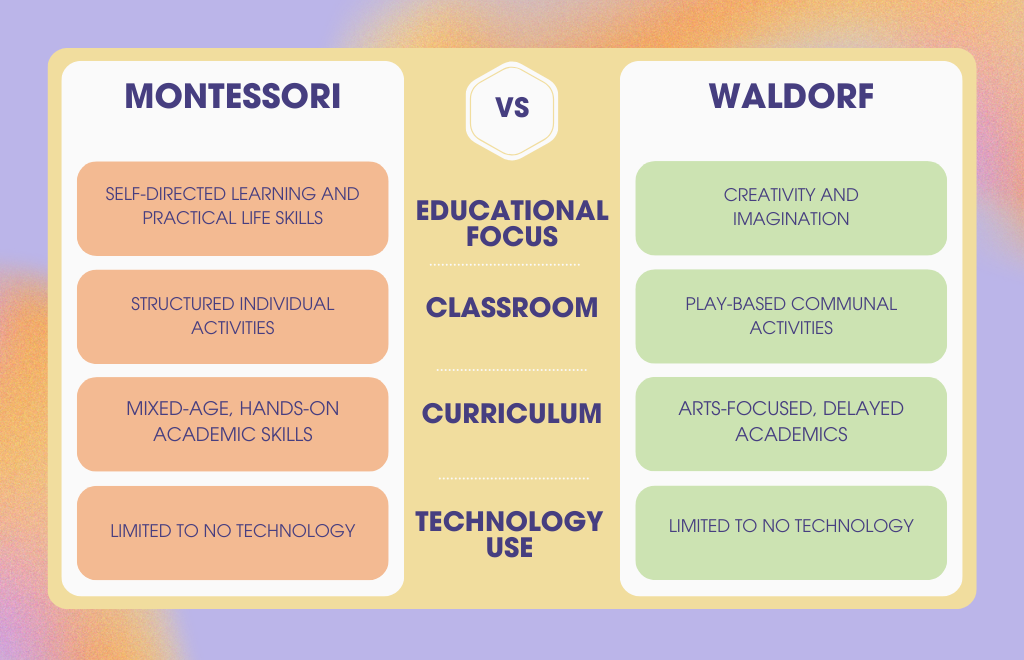
At a glance, Montessori education centers on self-directed activity, hands-on learning, and collaborative play. Children make creative choices in their learning, while the classroom and the teacher offer age-appropriate activities to guide the process. The Waldorf approach, on the other hand, emphasizes imagination in learning, encouraging students to explore their artistic and creative abilities through a curriculum rich in storytelling, arts, and crafts.
Comparison Chart
Classroom Setup
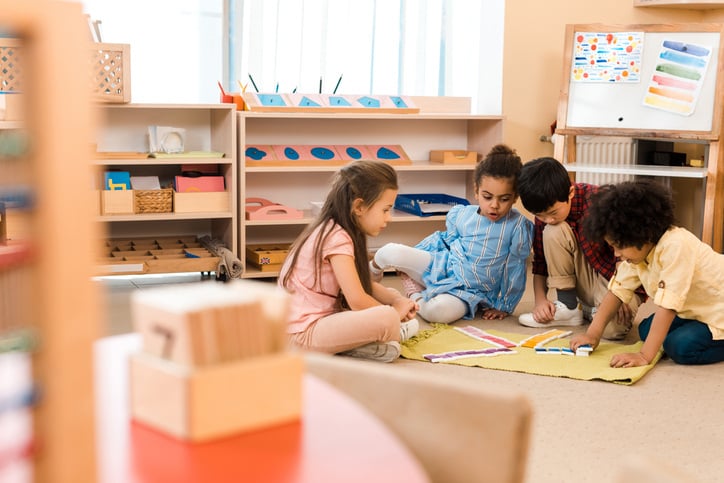
Walk into a Montessori preschool classroom, and one of the first things you’ll notice is the lack of “toys” in the traditional sense. The Montessori method focuses on developing practical life skills using carefully curated manipulatives. Montessori classrooms typically have a home-like feel and promote independence by making materials accessible on low shelves, encouraging children to self-select the activities that interest them.
Waldorf classrooms also promote freedom of movement and encourage choice but focus on creative and imaginative play. You will typically find open-ended materials like dolls, puppets, and play silks to encourage children to engage in pretend play. Many play items are made of natural materials that have a practical purpose. In Waldorf classrooms, children engage in cooking, sewing, and weaving with the teacher working alongside them.

Curriculum
Montessori early childhood classrooms are mixed-age, with children ranging from two or three to five years old. Children are empowered to make choices and move around the classroom freely, taking their choice of activity off the shelf and working independently or in small groups. The teacher acts as a guide, facilitating children’s exploration but rarely teaches the whole group at once. The daily schedule includes long chunks of uninterrupted “work” time where children engage with hands-on materials and manipulatives designed to develop early academic skills such as math and literacy. During snack times, children prepare their own snacks with child-sized utensils, set the table, and clean up after themselves.
The Waldorf early childhood curriculum also encourages exploration but focuses more on creativity, and academics are typically not formally introduced until the later grades. Waldorf schools often have rituals and celebrations around season changes and other aspects of nature, such as lantern walks and Harvest celebrations. Although religion is not part of the curriculum, Waldorf programs typically adopt a spiritual component to encourage reverence and respect for the earth and one another. The teacher rarely plays with the children but instead works nearby, engaged in tasks like cooking or sweeping, to redirect or guide the children if needed.
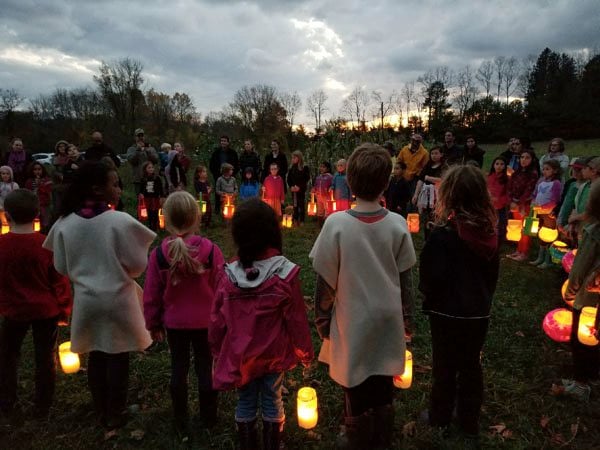
A Waldorf Lantern Walk. Photo Courtesy of Housatonic Valley Waldorf School
Technology
Montessori and Waldorf programs utilize little to no technology or screen-time in their early childhood classrooms. Both philosophies encourage exploration, movement, and hands-on manipulation of the environment, which is hard to replicate on a tablet or computer. As with most things, balance is critical, and some programs may be stricter than others when it comes to limits on technology in the classroom.
The Arts
Emphasis on the arts is where Montessori and Waldorf differ the most. Montessori programs typically spend very little time engaging in music, art, or dramatic play. However, in Waldorf preschool programs, children are encouraged to draw, paint and create with other art materials. Music is also a big part of the curriculum in Waldorf education.
How do you choose?
If you are still struggling to choose between Montessori and Waldorf, your best bet is to tour any programs you are interested in. Get a feel for the classrooms, the teachers, and think about which environment would be the best fit for your child. Be sure to ask the Director or teachers lots of questions and check out the school’s licensing information on their Winnie page.


