

Anne Halsall
Anne Halsall is Chief Product & Technology Officer (CPTO) and co-founder of Winnie. Anne leads product and technology at Winnie, including AI, platform and data.
Preschool is sometimes the first time children are in an environment without their parents, with structured learning, and with a lot of other children. It’s not unusual for all these changes to produce behaviors in your child that might be new and undesirable.
Common behavioral problems in preschoolers include tantrums, defiance, and difficulty sharing or taking turns. It’s normal for them to struggle with big emotions, which can lead to outbursts or frustration. You might also see things like hitting, biting, or acting out for attention as they navigate social situations and boundaries. These are all part of growing up, but they sometimes need a little extra help. Don’t fret! Here are some tips to deal with behavioral problems that may arise at preschool.
- Common preschool behavior problems
- Look first at home
- Observe your child in the classroom
- Establish a routine
- Get professional help
- Evaluate other preschools

Common preschool behavior problems
Preschoolers are still developing emotional regulation and social skills, so it’s normal to see a range of behavioral challenges. Some common issues include:
- Tantrums & Screaming – Difficulty managing emotions can lead to loud outbursts, frustration, or crying.
- Defiance & Oppositional Behavior – Saying "no" frequently, resisting instructions, or refusing to follow rules.
- Aggression (Hitting, Biting, Fighting) – Some children may struggle with conflict resolution and express frustration physically.
- Difficulty Sharing or Taking Turns – Learning to cooperate with peers is a key developmental milestone, but it takes practice.
- Bullying & Name-Calling – While young children may not fully understand the impact of their words, patterns of unkind behavior should be addressed.
- Anxiety & Separation Struggles – Some preschoolers experience stress when adjusting to new environments or routines.
- Acting Out for Attention – Engaging in disruptive behavior to get noticed by teachers or peers.
- Impulsivity & Focus Difficulties – Struggling to sit still, interrupting, or difficulty following multi-step instructions, which may be linked to attention-related challenges.
- Lying or Stealing – Some children experiment with dishonesty or taking things that don’t belong to them.
- Destroying Property or Throwing Objects – Expressing frustration by damaging toys, books, or classroom materials.
- Self-Harm or Harming Others – Rare, but concerning behaviors that may require professional guidance.
Understanding that these behaviors are part of early childhood development can help parents and teachers take the right approach to guide children toward positive behavior.
Look first at home
Sometimes a child acting out at preschool is due to changes in their home environment like a new sibling or a parent being busier than usual at work. Even if it seems unrelated, changes can weigh on a child and cause them to act out when they’re at preschool. Think about whether your child has gone through any changes recently and talk to her too about what may be on her mind. Many times, children will improve dramatically in their behavior after extra attention at home, like special one-on-one time with their parents.
When a child acts out at preschool, the root cause may not be in the classroom but at home. Young children are highly sensitive to changes in their environment, and even small disruptions can affect their emotions and behavior.
Possible Home-Based Causes of Preschool Behavior Issues
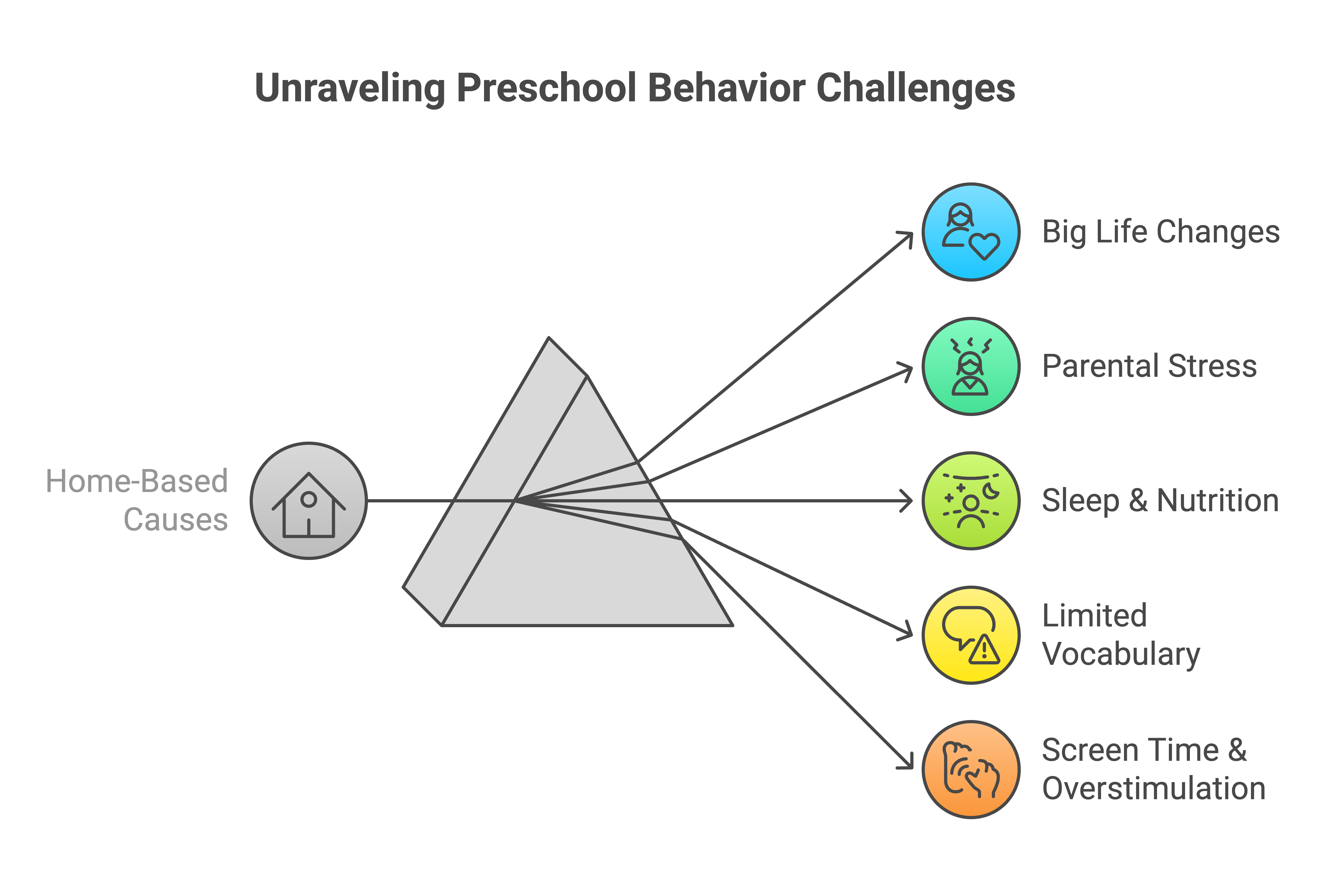
- Big Life Changes – Events like the birth of a sibling, a move to a new home, a parent traveling for work, or a family member's illness can create emotional stress.
- Parental Stress or Changes in Routine – Children pick up on family stress, whether from work, financial worries, or household tensions.
- Sleep & Nutrition – Poor sleep or inconsistent meals can make preschoolers irritable, leading to tantrums and defiance.
- Limited Emotional Vocabulary – Some children struggle to express their needs or frustrations verbally, leading to outbursts.
- Screen Time & Overstimulation – Excessive screen time, especially before school, can affect attention and self-regulation.
Observe your child in the classroom
Observing children in the classroom can be beneficial for two reasons. First, parents often benefit from seeing problems firsthand. Through observation, they can better understand the exact parameters of the issue. Parents can evaluate problematic behaviors like aggression by observing their intensity, frequency, and duration. If the behavior is harmful, occurs often, lasts over time, or resists simple interventions, it may indicate a need for professional help
Second, parents can witness how teachers are handling the problem. Observing the age-appropriate strategies teachers use to manage tantrums and other inappropriate behaviors can help maintain consistency at home when addressing these issues.
If you can’t observe your child in the classroom, ask the teachers to call or send home daily reports regarding the problem.
Establish a routine
Work with teachers to establish a consistent routine at school and at home. Children thrive on routine because it provides predictability and a sense of security. When they know what to expect, they feel more in control of their environment, reducing anxiety and behavioral outbursts. If a child is struggling with behavioral challenges at preschool, one of the most effective strategies is to establish a better routine.
Start with Morning and Bedtime Routines
A child's behavior at preschool can be influenced by how their day starts and ends. Mornings that are rushed, chaotic, or unpredictable can lead to stress and difficulty transitioning to school. Establishing a consistent wake-up routine that includes enough time for breakfast, getting dressed, and a calm activity—such as reading a book together or stretching—can set a positive tone for the day. Similarly, a structured bedtime routine, including a bath, a story, and a set lights-out time, can ensure a child is well-rested and ready for the next day. Sleep deprivation is a common cause of behavioral struggles, so prioritizing a healthy sleep routine is essential.
Coordinate Routines with Preschool Teachers
It’s helpful for parents to communicate with teachers about the structure of the preschool day and try to mirror some of those patterns at home. For example, if the class follows a structured snack time and quiet reading time before lunch, parents can introduce a similar routine on weekends to reinforce familiarity. This helps children transition more easily between home and school, as they recognize similar expectations in both settings. If teachers use specific language cues—such as a song to signal clean-up time or a countdown before transitioning between activities—parents can adopt those techniques at home to create consistency.
Align Discipline and Behavior Expectations
Preschool teachers often use techniques like "redirection" (gently guiding a child toward a different activity when they are acting out) or "positive reinforcement" (praising good behavior rather than focusing on negative behavior). When parents use similar strategies at home, it reinforces a unified approach to behavior management. For instance, if a child struggles with sharing, both teachers and parents can use consistent language like, "It’s his turn now, and you’ll have a turn next," instead of reacting with frustration. If a behavior chart or reward system is used at preschool, parents might consider implementing a similar system at home to maintain consistency.
Be Patient and Adjust as Needed
Routines take time to establish, and every child is different. Some may need more visual cues, while others respond better to verbal reminders. If a particular routine isn’t working, small adjustments—like adding extra time for transitions or incorporating a reward system—can make a big difference. Regularly checking in with teachers and caregivers can also help refine strategies and ensure that both home and school environments are working together to support the child.
Get professional outside help
Sometimes the problems cannot be solved at home or school. That’s when professional outside help can be a great option. Often, preschools can help recommend or help parents find therapists to assist children with different problems, such as behavioral issues or learning delays. If the behaviors keep happening or worsen even with consistent strategies, it might be helpful to talk to a developmental pediatrician or psychiatrist. They can help figure out if something like ADHD is at the root of the problem. These experts can offer advice to support your child’s development and help create better ways to manage behaviors.


