

Anne Halsall
Anne Halsall is Chief Product & Technology Officer (CPTO) and co-founder of Winnie. Anne leads product and technology at Winnie, including AI, platform and data.
The pandemic has altered how we live and work with many jobs now taking place remotely and many schools starting off the year in distance learning mode. Given these changes, Winnie, a marketplace for parents to find daycares and preschools near them, worked with Home Grown, a nonprofit initiative working to increase access to and the quality of home-based child care to survey over 1,000 parents to learn how the pandemic has impacted their child care choices and preferences.
The study showed that while group child care remains the most popular and ubiquitous form of caregiving, a new form of caregiving has emerged: working from home with kids. Overall, the number of families who keep their children in a parent’s care has surged from 38% to 52% — growth that is almost entirely accounted for by this new cohort of work-from-home parents. During the pandemic, the number of parents that rely on a work-from-home parent for child care has doubled from 13% to 26%, with parents citing safety and affordability as key drivers of their decision to keep kids home.
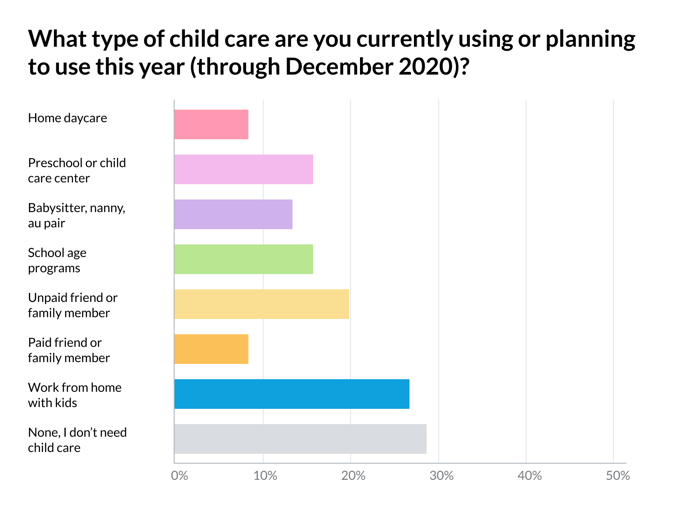
26% of families now rely on a work-from-home parent as primary caregiver
Working parents as primary caregivers
When asked about their ideal child care arrangement, the majority of parents surveyed (52%), preferred an environment out of their own home. The data is clear on this - parents want their kids to be in a setting with other children; this trend was true across all income levels and family arrangements. When parents are opting out of group environments, it’s primarily due to concerns about safety or because they are not operating onsite, as is the case with many K-12 schools.
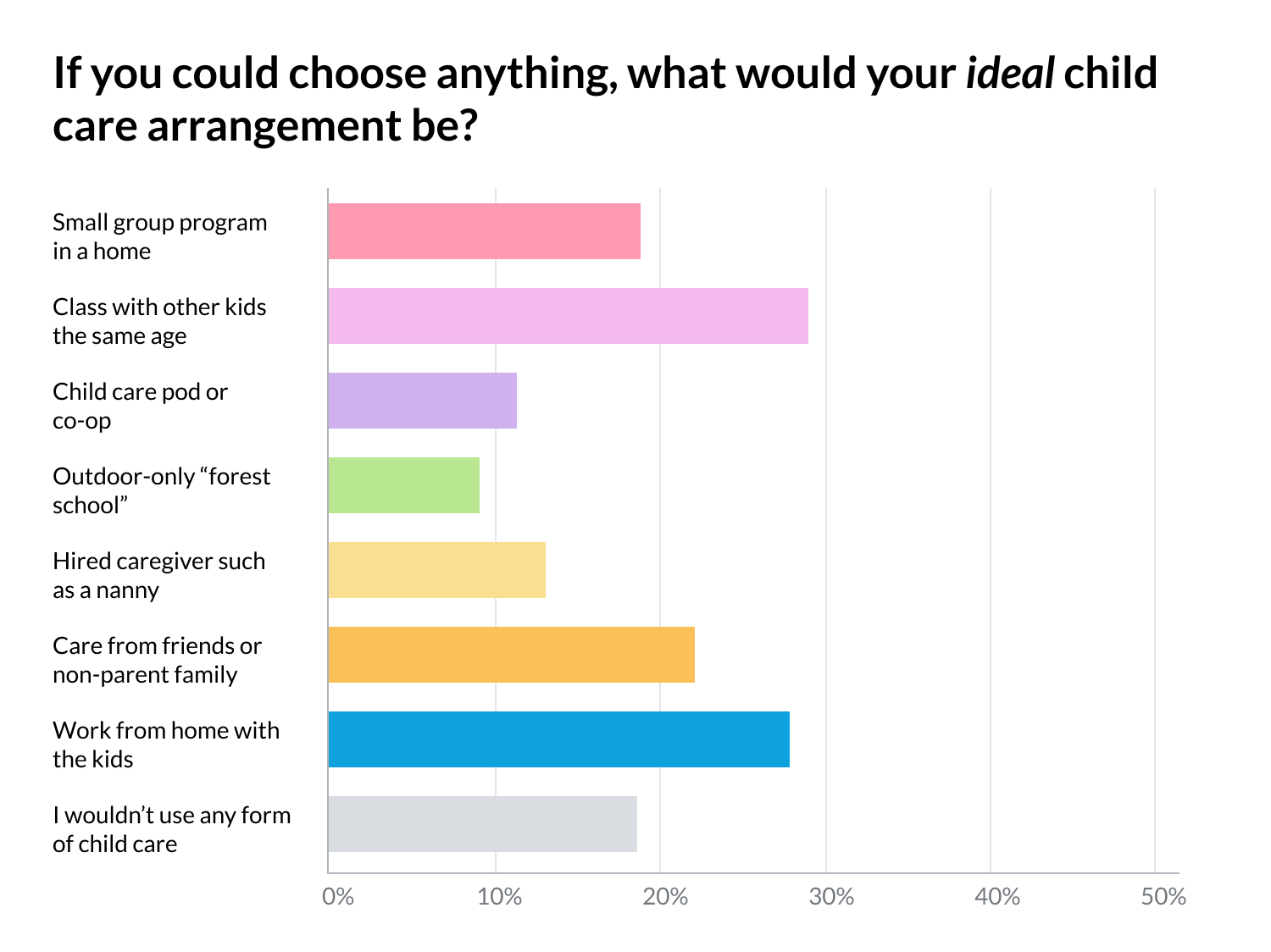
52% of respondents would prefer group care or school outside the home
Surprisingly, for 26% of respondents, working from home with kids is their planned child care arrangement through 2020. This is true even when looking at parents of young children. This arrangement can cause significant stress, particularly if employers are not supportive. It's also something many employers are not prepared to accommodate.
Home-based care is increasing in popularity
Licensed home-based child care was used by 10% of families with kids under age 5 before the pandemic. Now that usage is up to 13%, and 20% of parents with kids under age 5 surveyed say it’s now their preferred form of care. This increase is significant and notable because the use of other forms of group care (licensed daycare, preschool, and school age care programs) has decreased during the same time period.
“Home-based care can help those families struggling to find safe, affordable, flexible child care. During the pandemic, we've seen the reliance on home-based child care increase, as child care centers, schools, and Head Start programs have struggled to accommodate social distancing,” said Natalie Renew, Director at Home Grown. “Home-based child care providers remained open to serve the children of essential workers and are well positioned to continue to help families get back to work.”
Pods have not been widely adopted
Despite the media coverage, only 8% of parents of school age kids have entered or intend to enter into a pod or shared care arrangement. The most popular form of child care for school age children who are distance learning is parent care, with 53% of parents using this option.
Recommendations
These data indicate that we need to support families who will be juggling work and care along with online learning. We also need to sustain the supply of child care, both center and home-based, so that children can return to these programs when families feel comfortable. There are currently several bipartisan bills to invest up to $50B in stabilizing the child care industry and various ways to support parents now with educational, mental health and material supports while their children are home.
Methodology
Based on a survey from August 20 - September 3, 2020 of 1008 working parents with children under 13 years of age living in the United States. 594 (59%) have all parents in the workforce. 634 (63%) have at least one parent working outside the home. 487 (48%) have at least one parent working from home. 472 (47%) have at least one parent not in the workforce.
Race
- White: 620 (62%)
- Hispanic or Latino: 140 (14%)
- Black or African American: 69 (7%)
- Native American or American Indian: 27 (3%)
- Asian / Pacific Islander: 109 (11%)
- Other: 19 (3%)
- Prefer not to say: 14 (1%)
Household Income
- <$25,000: 134 (14%)
- $25,000-$49,999: 200 (21%)
- $50,000-$74,999: 202 (21%)
- $75,000-$99,999: 163 (17%)
- >$100,000: 210 (22%)
- Prefer not to answer: 41 (4%)


