
-1.jpg?height=100&name=Image%20from%20iOS%20(2)-1.jpg)
Winnie
Choosing the right school for your child isn’t easy. Along with traditional public schools and private schools, parents today often hear about magnet schools and charter schools as alternatives. While both are tuition-free, they have different structures, goals, and ways of serving students. Understanding these differences can help you decide which option is best for your child.
What Is a Magnet School?
Magnet schools are public schools that offer a specialized curriculum or academic theme. The idea is to “magnetize” or attract students from across different neighborhoods and even outside of their assigned district boundaries. These schools were first developed in the 1960s and 70s as a way to promote diversity and provide families with more educational options.
A magnet school might focus on a subject area like science, technology, engineering, and math (STEM), performing arts, or world languages. Some offer International Baccalaureate (IB) programs, while others emphasize career and technical pathways. Magnet schools are usually operated by the local school district, which means they are accountable to the same district oversight as other public schools.
Admissions policies vary. Some magnet schools are open to all students but use a lottery system if more families apply than there are available seats. Others are selective, requiring auditions, portfolios, or entrance exams for programs that emphasize the arts or advanced academics.
What Is a Charter School?
Charter schools are also tuition-free and publicly funded, but they are independently managed. Each school operates under a “charter,” which is essentially a contract with a state or local authority that grants the school greater flexibility in exchange for accountability for academic results and financial practices. This independence allows charter schools to experiment with different teaching models and organizational structures.
The curriculum and approach can vary widely from one charter school to another. Some are college-preparatory, while others use Montessori or project-based learning. Charter schools are designed to be open to all students within a defined area, and if applications exceed available seats, enrollment is typically determined through a lottery. Unlike magnet schools, transportation is not always guaranteed, which can make access harder for some families.
Because charter schools are operated by independent nonprofit boards or organizations rather than the district itself, quality can vary significantly depending on the management and oversight in place. Some charter schools are highly successful and in demand, while others have faced criticism for underperformance or lack of accountability.
Key Differences Between Magnet and Charter Schools
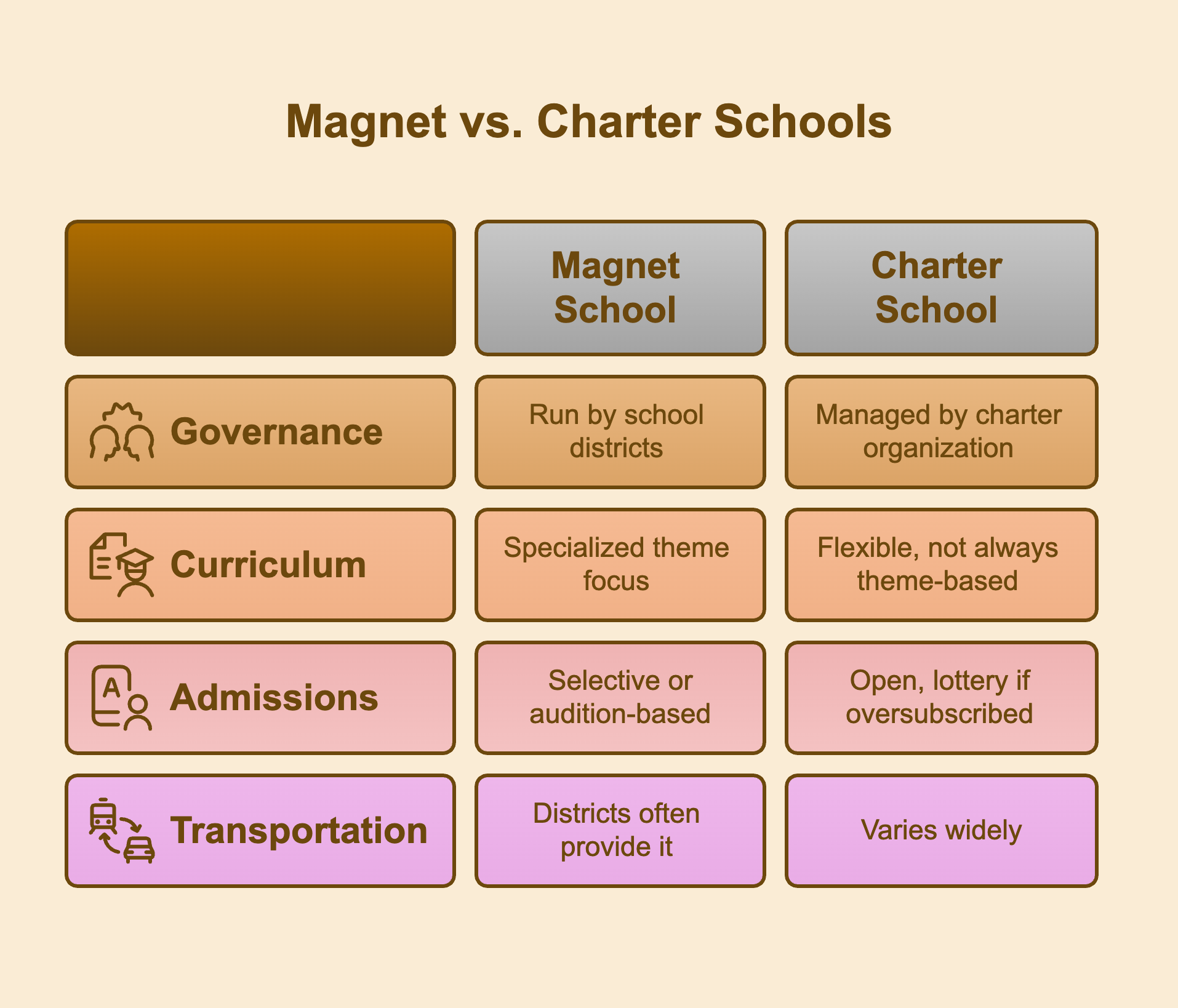
Although both magnet and charter schools are considered alternatives within the public school system, they differ in several important ways. Magnet schools are governed by school districts and tied to district resources, while charter schools are managed independently under their charter agreements. Magnet schools tend to center around a particular theme, like STEM or the arts, whereas charter schools may or may not have a specialized focus but often emphasize innovative teaching approaches.
Admissions also differ. Magnet schools sometimes use selective criteria or auditions, especially for arts programs, while charter schools are typically open enrollment, relying on lotteries only when demand exceeds available spots. Transportation is another key difference: many magnet schools provide it as part of their mission to attract students from diverse neighborhoods, but charter schools may not offer the same level of support.
Similarities Between Magnet and Charter Schools
Despite these differences, magnet and charter schools share some important similarities. Both are tuition-free, making them accessible alternatives to private schools.
Both types of schools also emphasize innovation. Magnet schools do this by offering a themed curriculum that enriches students’ learning experiences, while charter schools innovate through flexible governance and new teaching models. For families seeking something different from a traditional public school setting, both magnet and charter schools can provide appealing options.
Pros and Cons for Parents to Consider
Magnet schools have the advantage of offering specialized programs that align with a child’s interests or talents. For example, a student passionate about music or science may thrive in an environment where those subjects are emphasized every day. Because magnet schools are district-run, families also benefit from district oversight and, in many cases, free transportation. The drawbacks, however, include competitive admissions processes and the possibility of longer commutes if the school is not located nearby.
Charter schools, on the other hand, may appeal to families who value innovative teaching approaches or who feel their child needs a different type of classroom experience. Many charter schools operate with smaller class sizes or unique learning models, which can be a good fit for students who struggle in traditional settings. Still, charter schools vary widely in quality, and not all provide transportation or the same level of special services that district-run schools offer. Parents may need to do more research to evaluate whether a charter school is well-run and successful.
When to Consider Each
If your child has a clear passion or talent area, such as performing arts, STEM, or language immersion, a magnet school might be the best choice. These programs are designed to deepen learning in specific subject areas and can provide valuable opportunities for enrichment.
If you’re looking for a school with a different educational philosophy—whether it’s project-based learning, college preparation, or an alternative teaching method—a charter school might be a better fit. Charter schools can be a good option for parents who want flexibility and are willing to carefully evaluate individual schools for quality.
Finding Options Near You
The availability of magnet and charter schools varies widely by region. Some school districts offer multiple magnet programs across different themes, while others have few or none. Charter schools are often concentrated in certain states and metropolitan areas but may be harder to find in smaller communities.
To explore options in your area, start with your Winnie's K-12 school search or search specifically for charter schools or magnet schools.
By understanding the differences and similarities between magnet and charter schools, you’ll be better equipped to navigate your options and choose an environment where your child can thrive.


