

Anne Halsall
Anne Halsall is Chief Product & Technology Officer (CPTO) and co-founder of Winnie. Anne leads product and technology at Winnie, including AI, platform and data.
Early childhood education can be confusing, especially when terms like preschool, Pre-K, Transitional Kindergarten (TK), and Voluntary Prekindergarten (VPK) are used in different ways depending on your location or what provider you're talking to. These programs sometimes serve different purposes and stages of development, but they can also overlap in the age groups they serve. The names used for each program may also vary from region to region.
All four are designed to help children get ready for kindergarten, but they differ in structure, curriculum, and setting. Understanding these differences can help you choose the right program for your child.
In this guide, we’ll break down when children typically attend preschool, Pre-K, and Transitional Kindergarten, and what you can expect from each.
Preschool curriculums focus on advancing socially and emotionally
Of the three terms, preschool is the most general. Preschools generally offer early childhood education to kids between two and five years old. Kids who attend preschool learn basic social, emotional, and academic skills that lay a foundation for the rest of their educations.
While preschool has traditionally been offered through private providers, in recent years, it has increasingly become a part of the public school system. Several states and the District of Columbia have begun offering public preschool, and states like Florida, Oklahoma, and Vermont have pioneered universal access for 4-year-olds. According to statistics from the First Five Years Fund, many other states, including California, New York, Georgia, and Colorado, have followed suit by implementing or expanding universal programs that provide free pre-K regardless of income.
What's the difference between preschool and Pre-K
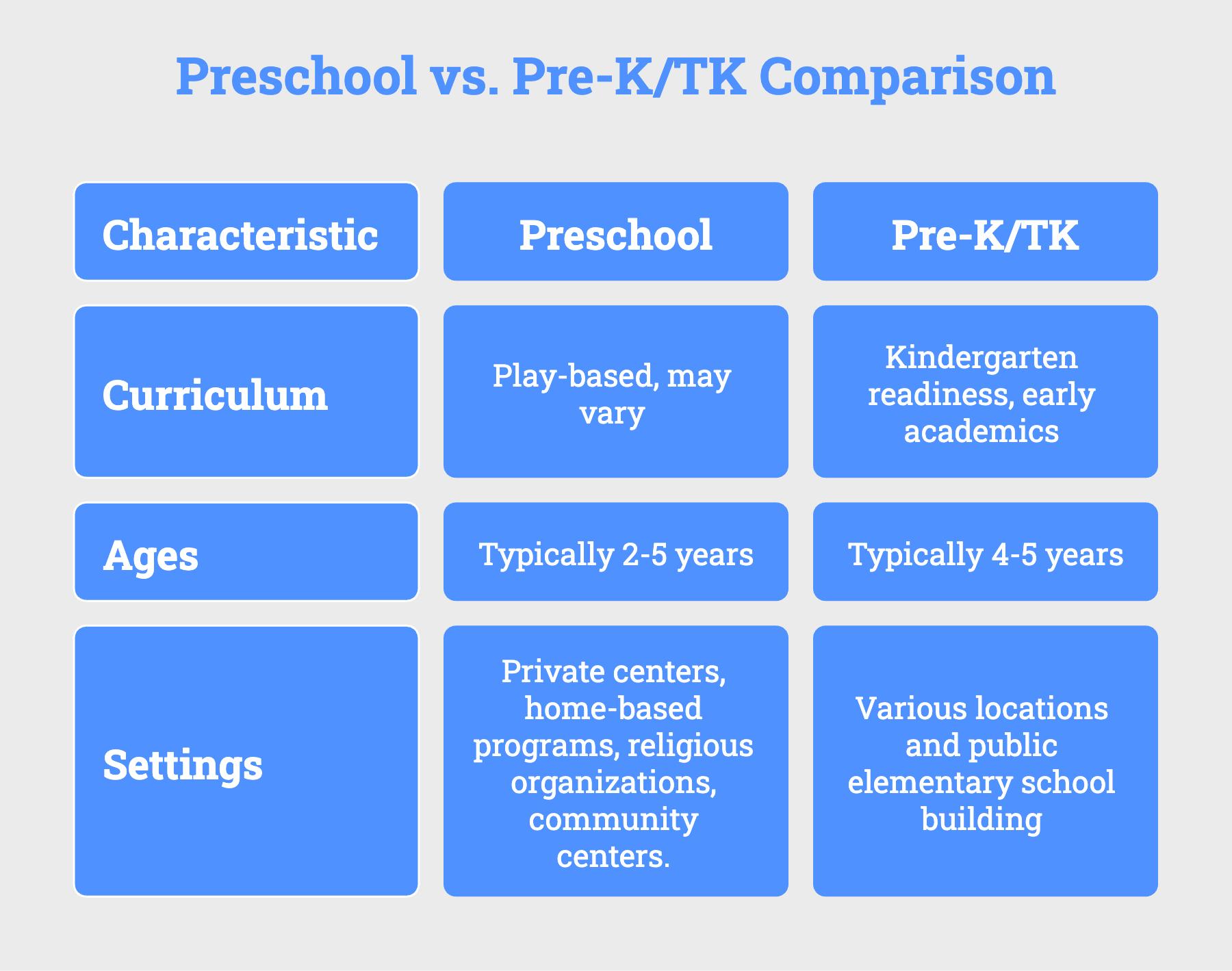
The term preschool is broad and can be used to describe programs for children as young as 18 months but typically describes programs for ages 2-5. Pre-K typically only refers to programs for children who are 4-5 and sometimes 3 turning 4, depending on where you live. Pre-K is geared toward preparation for Kindergarten and tends to be a bit more focused on pre-academic skills like literacy and math.
Pre-K classrooms can be located in private centers, home-based programs, religious organizations, and community centers, but they can also be part of the public school system depending on where you live. Depending on where the Pre-K program is located, they may have different licensing guidelines for things like staff-to-child ratio and health and safety policies. You can find out more about a program's licensing information by checking out their profile on Winnie.
Pre-K is a great place for kids to practice skills they’ll need in Kindergarten
Pre-K (or Pre-Kindergarten) is for older preschoolers who are getting ready to attend Kindergarten in the next year. It’s still considered preschool even though it’s called Pre-K. Four and five-year-old children who are not yet old enough or ready for TK or Kindergarten can attend Pre-K. It’s not always offered through the public school system, but it is available in some districts.
Pre-K is a great place for kids to transition from traditional preschool to Kindergarten. In Pre-K, children specifically work on building kindergarten readiness skills, and teachers dive deeper into subjects like math and science.
Voluntary Prekindergarten in Florida (VPK)
If you live in Florida, you may have heard of Pre-K being referred to as VPK. VPK (Voluntary Prekindergarten) is a free program for 4-year-olds. Like many Pre-K programs, it focuses on building early reading, math, and social skills in preparation for kindergarten, with the main difference being that it is available with no cost to Florida families.
Transitional Kindergarten (TK)
Transitional Kindergarten, similar to Pre-K, is for older preschoolers who are getting ready to attend Kindergarten in the next year. Sometimes it refers specifically to a program offered by the public school system for children who turn five years old during certain months of the year. Like preschool and Pre-K, it’s not required that kids attend.
When TK is part of the public school system, it is typically located in elementary schools, near the Kindergarten classrooms. In the case that it is offered through the public school system, it is typically free to families though there may be costs for things like onsite after-care.
In TK classrooms, teachers use a modified Kindergarten curriculum that’s age-appropriate and developmentally appropriate for students who turn five years old in the fall. TK students are generally a little older than preschoolers and Pre-K kids, so teachers expect them to have longer attention spans and display more independence.
Preschool, Pre-K, and TK are all great options for children at different stages in their development and kindergarten preparedness and the exact definition of the program will vary from provider to provider. To find and compare all the options near you, check out Winnie’s preschool search.
Full-time vs. part-time programs
One of the primary concerns parents have is whether these programs are full-time or part-time. Let's address this question for each of the three programs.
Preschool: Preschool programs can vary in terms of duration and schedule. Many preschools offer both full-time and part-time options to accommodate parents' needs and children's developmental readiness. Full-time preschool programs typically operate for the entire school day, which is similar to a traditional elementary school schedule. Part-time preschool programs, on the other hand, may offer half-day sessions or specific hours during the day, typically two to five days a week.
Pre-K: Pre-K programs are designed to prepare children for kindergarten, focusing on important academic and social skills. Similar to preschool, Pre-K programs can be found in both full-time and part-time formats. Full-time Pre-K programs often follow a schedule similar to that of a typical elementary school day. Part-time Pre-K programs may offer fewer hours per day or fewer days per week, providing children with a gradual transition into a structured learning environment.
TK (Transitional Kindergarten): TK is a program specifically designed for children who are nearly ready to enter kindergarten but would benefit from an additional year of developmental growth before moving on. Like preschool and Pre-K, TK programs offer both full-time and part-time options. Full-time TK programs may align with regular elementary school hours with onsite after-care available.
Full-time programs and developmental considerations
Parents often wonder if a full-time program might be too much for their young child and whether it is the best choice to prepare them for elementary school. Here are some important points to consider:
Young children adapt: Full-time programs can provide a comprehensive learning experience for children, but it's essential to consider their developmental readiness and adaptability. Young children may require more breaks and rest periods throughout the day to maintain their energy levels. It's important for full-time programs to balance structured learning with age-appropriate play and rest.
Preparation for future schooling: Full-time programs can offer valuable preparation for the transition to elementary school. They provide children with opportunities to develop routines, build independence, and enhance social and academic skills. However, the readiness of a child to handle a full-time program depends on their individual temperament, energy levels, and overall well-being.
What happens after Pre-K?
Typically, after Pre-K a child will go to Kindergarten in either a public or private school. However, if your child is on the younger end or doesn't seem developmentally ready for Kindergarten, they can do a second year of Pre-K or TK. Talk to your child's school and teachers to make an informed decision about the next steps.


