

Anne Halsall
Anne Halsall is Chief Product & Technology Officer (CPTO) and co-founder of Winnie. Anne leads product and technology at Winnie, including AI, platform and data.
The Montessori method has been a popular method of education in the U.S. for decades, preferred by many parents and schools because of its child-centric approach to learning and personal development. But there are advantages and disadvantages to every type of education, so make sure to consider the Montessori method pros and cons when exploring this preschool option for your child.
To help parents better evaluate the advantages and disadvantages of Montessori, here are some pros and cons outlined below.
The Pros of Montessori
Learning is done through play, exploration and projects
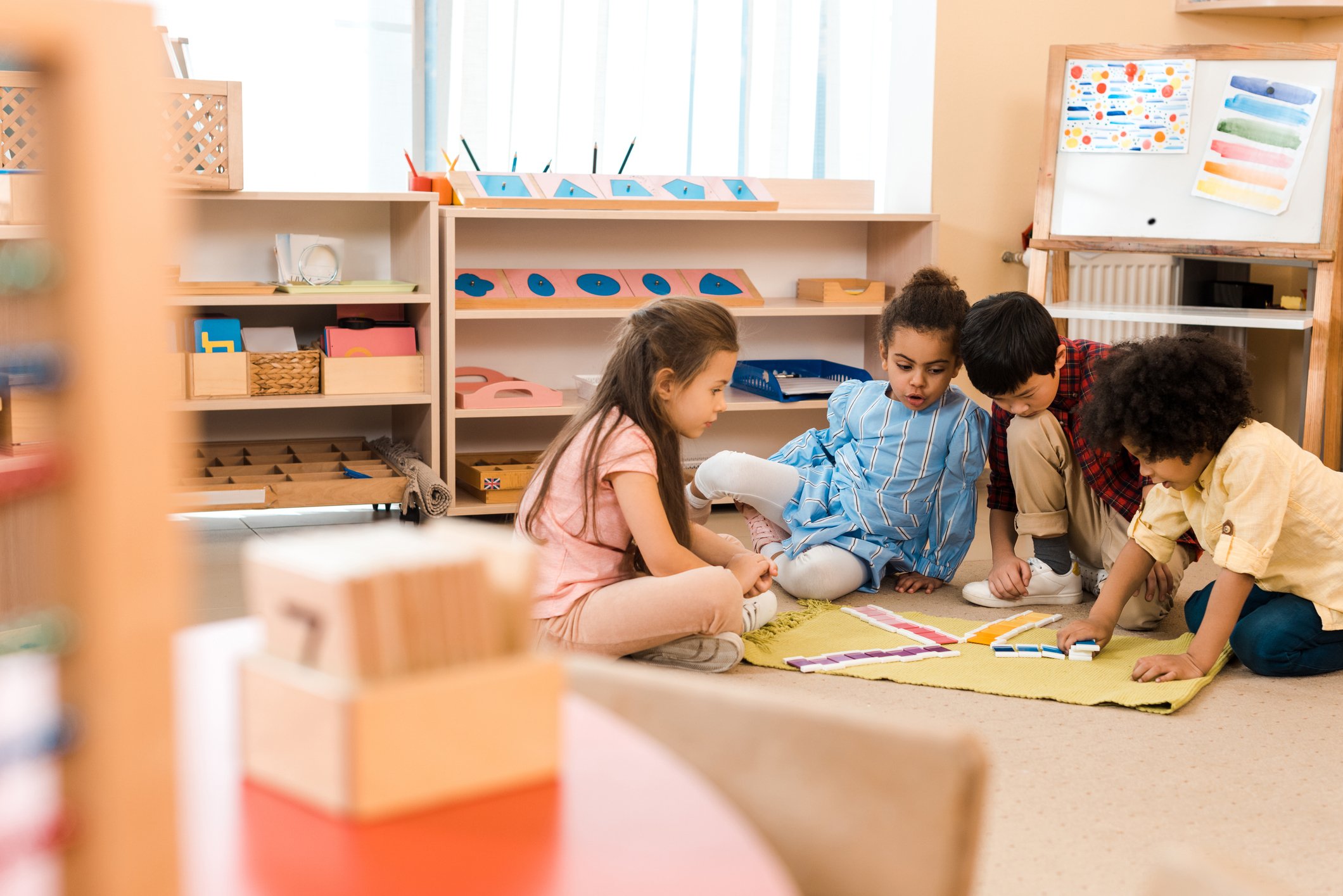
With Montessori preschool programs, there is less pressure to memorize and complete assigned work as one might expect in a traditional learning environment. Children develop a love of learning by choosing projects and activities on their own in a Montessori classroom. Learning materials are often designed to teach one skill or concept at a time: colorful beads are available to help teach math, puzzle maps allow students to explore geography, 3D letters help students learn the alphabet and form words. Montessori learning materials may differ from classroom to classroom, but they primarily encourage discovery and self-learning.
Montessori focuses on the whole child with an individualized approach
Traditional schooling typically treats a class as a whole unit, using the same teaching materials and methods for each student, such as homework and tests. With Montessori, lessons, and activities are tailored to fulfill an individual child’s developmental needs. Each student works at their own pace on activities that interest them and the teacher guides the student when necessary. The Montessori method also encourages growth in a child’s emotional and social development, not just academics.
The classroom environment prepares students for the real world
Children learn various skills in the Montessori classroom. Since students are grouped in age ranges that span two to three years, older kids and younger kids are able to socialize and learn from one another. This approach helps develop leadership, communication, and social and emotional skills. There is also a strong focus on manners and respect towards others, as well as the teachers and materials they engage with each day. If disagreements arise, children can learn how to handle them with manners and grace.
The cons of Montessori
Kids can have trouble transitioning from Montessori to traditional schooling
One disadvantage of Montessori schooling is the lack of programs that include high school students (fifteen to eighteen-year-olds). If your child must transition to traditional schooling when Montessori is no longer available, or not an option for the family, it may be hard to adapt. Traditional classrooms will be less hands-on and more structured with rules, homework, projects, and lectures. However, a change like this can be seen as a life lesson and an opportunity to grow.
The curriculum may be too relaxed
Independence is certainly an advantage for some children, but others may not thrive as well with less structure and a higher value placed on independence. Some children like routine and stricter discipline, which can create a sense of comfort and order. More freedom in the classroom environment doesn’t always mean a student will take it upon themselves to learn something new or improve their skills. Since Montessori classrooms are composed of multi-age groupings, it may be difficult for your child to not compare him or herself to others and their abilities. However, this is often a temporary setback as your child integrates into their new environment.
Cost can be expensive
Since Montessori schools operate independently of one another, tuitions can vary. There are examples of median annual tuition by age groupings online, but keep in mind that these figures may be outdated and are dependent on your area’s cost of living. Also, not all Montessori schools are private and require tuition; many public schools offer Montessori programs that do not charge tuition to students within their district.
Any school can call itself Montessori, and some communities lack an official program
Depending on where you live, you may not have an official affiliated Montessori program within close range of your home or place of work. If the Montessori school you choose is a private school, you’ll likely have to provide your own transportation. Time spent commuting could be considered part of the costs of choosing a Montessori school for your child.
The term “Montessori” is not restricted, so any school can brand itself a Montessori school without offering certified teachers. Parents must do their research to ensure that a school they’re considering is an official, certified Montessori school.
If you decide that the Montessori method is right for your family, evaluate the Montessori method pros and cons carefully. Then, find a Montessori school or teacher that fits your criteria for your child’s schooling. You can find the right preschool near you or daycare near you on Winnie.
Updated May 17th, 2021


