

Anne Halsall
Anne Halsall is Chief Product & Technology Officer (CPTO) and co-founder of Winnie. Anne leads product and technology at Winnie, including AI, platform and data.
When it comes time to choose a preschool, the options can seem overwhelming. Do you need an in-home daycare provider or a preschool program … and what’s a Montessori school? These are all common questions we get from parents all the time, which is why we’re diving into what Montessori is and how it can differ from other preschools.
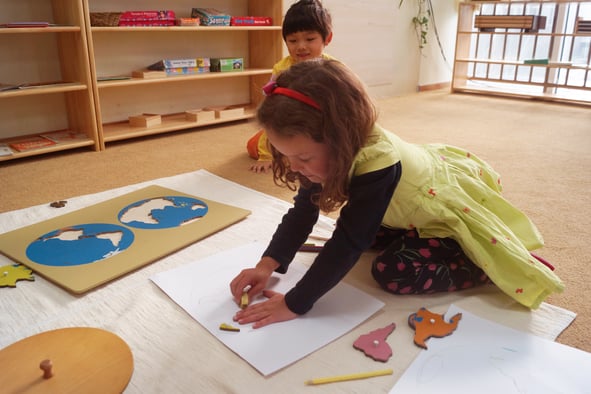
What is Montessori?
Montessori is a method of education that was started by Maria Montessori, an Italian educator, around 1896. Through her teaching experience and observations of children in her classroom, she developed her namesake method, which she used for her own school in Rome. By 1912, Montessori had come to America, but it really gained traction in the 1960s. Since then, it’s been a popular institution in early childhood education.
Aside from the history of this educational style, Montessori is a type of early childhood education where exploration is front and center. Children learn by engaging with their environment and, based on what Maria Montessori and others have observed, they develop best when given the tools to explore on their own. Children can learn at their own pace in an environment that is specifically created to support them.
Of course, this may seem similar to a number of preschools or daycares, but Montessori stands out in a number of ways.
-1.png?width=3320&height=3224&name=_-%20visual%20selection%20(1)-1.png)
What are the differences between Montessori and preschool?
Some of the major differences between Montessori and traditional preschool include child-directed vs. teacher-directed instruction, the classroom environment and materials used, and free-play vs. work. There is also a broader age range of children in Montessori classes versus a single year in preschool.
If you’re trying to decide whether to enroll your child in a more traditional preschool or a Montessori program, it can be difficult to tell the difference. However, there are a few components to Montessori that you should consider:
Child-directed vs teacher-directed instruction
Montessori is child-lead, but this isn't to say that it's a free-for-all or the teacher isn't still "in charge" of the classroom; it's just a difference in opinion when it comes to the role of the teacher. In a Montessori classroom, children learn at their own pace and take more ownership over their learning than in a traditional preschool program. The differences in the role of the teacher between Montessori and traditional preschool programs can be broken down into two categories:
- Child-directed or child-driven means that the child is in charge of their learning process. The teacher acts as a guide in the Montessori classroom, providing support for children to help them get to the next level in their development but the children are otherwise independent and free to choose their activities for the day.
- Teacher-directed or teacher-driven programs typically include more activities that are chosen by the teacher and are completed by the whole group. Children may still have freedom of choice, but it may be from a smaller range of activities that the teacher has designated for the day. In a teacher-directed preschool program, the teacher is viewed as the key to unlocking a child's potential, as opposed to Montessori who views the child as the key.
Working vs. playing
In a typical preschool classroom, children spend much of the day playing and interacting with various materials in the classroom including toys, art materials, dramatic play materials, etc. In fact, many preschool programs identify themselves as being "play-based".
Now, there is nothing wrong with play, in fact, we know that children learn best through play, but Montessori doesn't refer to what children do in the classroom as play (even though it may look like it).
The founder of the Montessori method, Maria Montessori, once said, "play is the work of the child," and Montessori classrooms often substitute the word "work" for "play". Children can choose from various materials during work time that range from more academic (counting beads and letter-work) to more open-ended and imaginative (practical life and kitchen). In addition, there are routines around cleaning things up and putting them away before moving on to the next activity.
Other early childhood programs have also adopted using the word work to describe their free-play or choice times, as it helps put into perspective how truly critical play is to a young child.
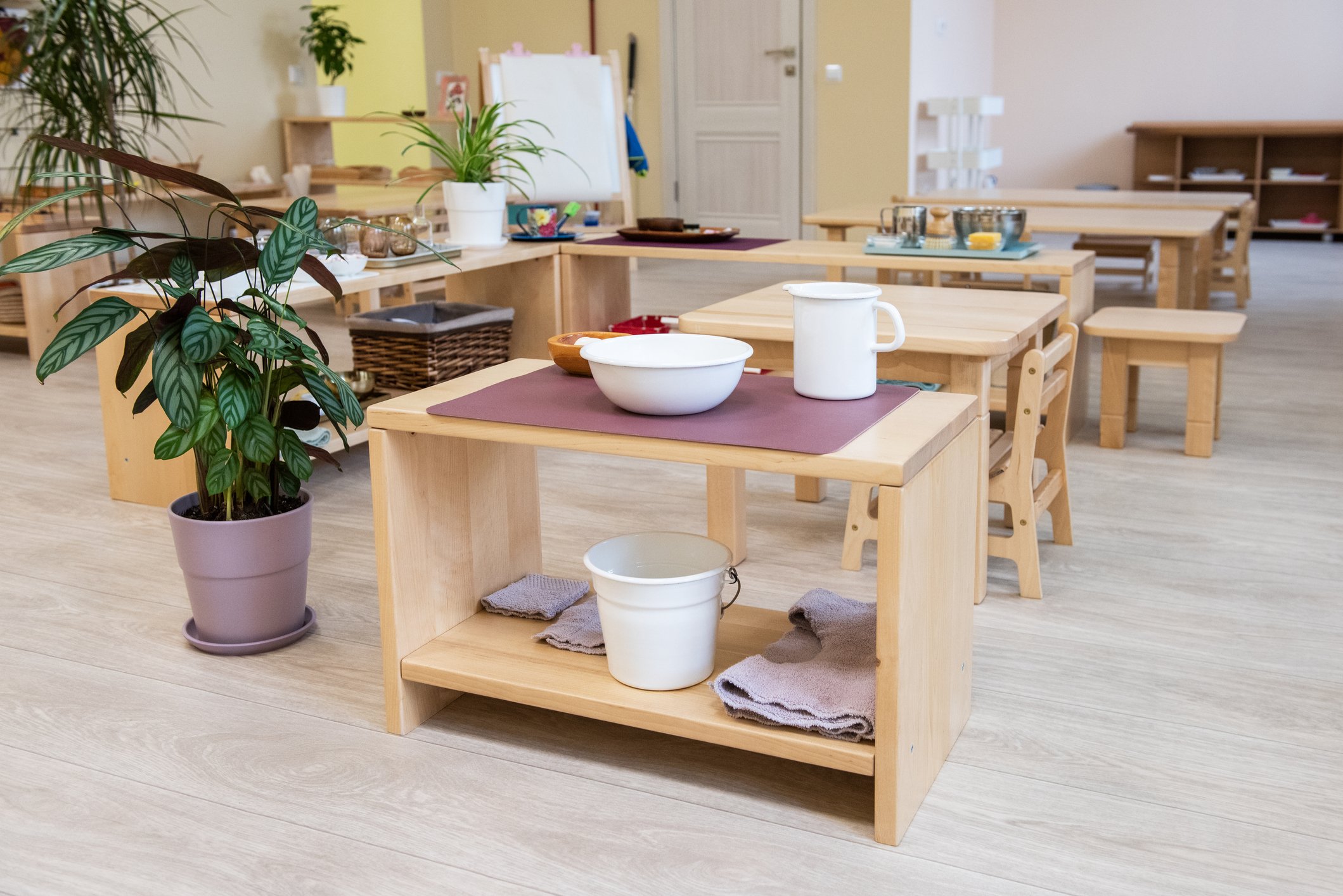
The classroom environment
In a traditional preschool program, the classroom may be filled with bright primary colors and engaging wall displays. The materials are typically arranged into "centers" or "areas" (block center, math center,etc) and children sit at tables to eat and work.
Montessori classrooms tend to look different than typical preschool classrooms, especially when it comes to the color palette. The classroom is divided into the different curriculum areas: Practical Life, Sensorial, Math, Language, and Cultural (Art, Science, Geography). Shelves are child-height and generally well-organized with evenly spaces materials to allow children to easily choose their activity and put it back when they are done.
Montessori classrooms also tend to be much more minimalist, utilizing neutral colors and wooden materials. The Montessori classroom may be busy, but is meant to feel calm and peaceful at the same time.
What are the benefits of Montessori?
A major benefit of the Montessori method is that it is, in general, child-centered and less focused on a structured curriculum. This means higher engagement with children during the day, as well as more social learning experiences. Montessori programs also believe in child-led learning, which means that children with different needs will be considered individually, rather than compared to the class as a whole.
Studies also show that children in Montessori programs exhibit higher “executive function, reading, vocabulary, mathematics and social problem-solving” than kids in traditional preschool. Other studies also find that Montessori education “predicts significantly higher mathematics and science standardized test scores in high school.”
Of course, none of this is to say that traditional preschools don’t use similar methods, or that your child won’t learn as much. The main difference between Montessori and other preschools with similar ideology comes down to certification.
Make sure it’s a real Montessori program
For it to be a true Montessori program, the teacher leading the class must have an affiliation with the American Montessori Society. (If there is a school of multiple classrooms, the entire school should be certified.) Without this certification, a teacher may be familiar with Montessori methods but not actually trained in them.
AMS (American Montessori Society) and AMI (Association Montessori Internationale) are two of the most well-known Montessori certification organizations. AMS is a US-based organization that offers training programs and accreditation to Montessori schools in the US and around the world.
AMI, on the other hand, was founded by Dr. Montessori herself and is based in the Netherlands. AMI offers training and accreditation to Montessori schools globally. While both organizations share a common Montessori philosophy, there are some differences in their approach to training and certification.
AMS programs tend to be more flexible and allow for some adaptation to local cultural and educational norms. AMI programs, on the other hand, adhere more strictly to Dr. Montessori's original teachings and methods. Parents should research both AMS and AMI programs and choose the one that best aligns with their educational goals and values.
If you believe Montessori is the right choice for you and your child, browse Montessori schools in your area. Not sure a school or program is officially affiliated with the AMS? Winnie can help you find an accredited Montessori program in your area. We feature AMS/AMI certifications on our program pages to help you as you make your decision.
.png?width=2240&height=1260&name=Accredited%20Montessori%20programs%20will%20have%20this%20indicator%20(1).png)
No matter which preschool or educational style you prefer, there are plenty of preschool options in your area. Keep in mind that it’s important to meet with school directors and teachers who will be caring for your child, regardless of the teaching style. This interaction is arguably just as important as the education your child receives. If a provider or program doesn’t “click” with you, keep moving. Your instincts as a parent will let you know what type of education is right for your child.


