

Christine Hernandez
Early childhood educator, writer, and mother. Your friendly neighborhood guide to all things parenting.
When it comes to choosing the best education for your child, two popular options often come up: traditional private schools and Montessori schools. While both can provide a high-quality education, the approaches they take to learning are quite different. Understanding the differences between private schools and Montessori schools can help you make an informed decision based on your child's needs and your family’s educational goals.
- What Is a Montessori School?
- What Is a Traditional Private School?
- Montessori vs. Private School: Key Differences
- Are Montessori Schools Private?
- Is Montessori Elementary Worth It?
- Finding the Right School for Your Child
What Is a Montessori School?
Montessori schools are based on the educational philosophy of Dr. Maria Montessori, which emphasizes hands-on, self-directed learning, independence, and a child-centered approach. The Montessori method encourages children to learn at their own pace, explore topics that interest them, and work independently or in small groups. Some of the key features of a Montessori school are:
- Child-Led Learning: In a Montessori classroom, children choose their activities and work independently, allowing them to explore their interests.
- Mixed-Age Classrooms: Montessori schools often group children in multi-age classrooms, typically ranging from 3 to 6 years, 6 to 9 years, and so on. This promotes peer learning, collaboration, and mentorship among students.
- Hands-On Learning Materials: Montessori classrooms are filled with tactile, self-correcting materials designed to teach specific concepts like math, language, and sensory development.
- Emphasis on Independence: Children are encouraged to take ownership of their learning, making choices and developing independence from an early age.
What Is a Traditional Private School?
Private schools, on the other hand, generally follow a more structured and teacher-directed approach to education. These schools vary widely in their educational philosophies, but they typically offer a traditional curriculum with a clear focus on academic achievement, preparing students for higher education.
Key Features of Traditional Private Schools:
- Teacher-Led Instruction: Private schools follow a structured curriculum where teachers lead lessons, set goals, and assess student progress through tests and assignments.
- Grade-Level Classrooms: Unlike Montessori schools, private schools group students by age and grade level, which follows a more linear progression of academic content.
- Academic Rigor: Private schools often emphasize strong academic performance, with a focus on preparing students for standardized tests and college admissions.
- Extracurricular Activities: Many private schools offer a wide range of extracurriculars, such as sports, arts, and clubs, fostering well-rounded development.
Montessori vs. Private School
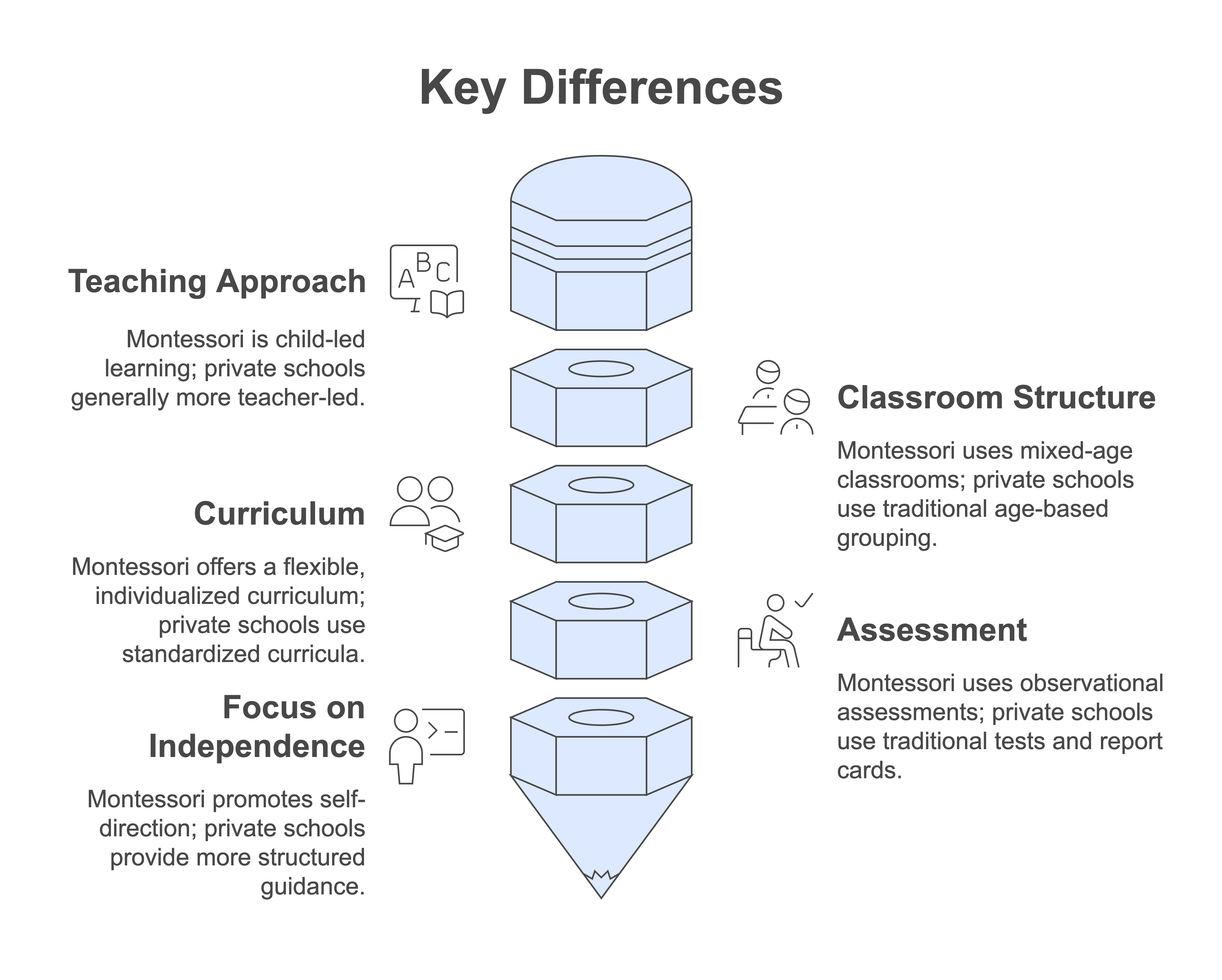
- Teaching Approach
- Montessori: Emphasizes child-led learning with a focus on independence and hands-on experiences.
- Private School: Follows a structured, teacher-led curriculum focused on academic performance and preparation for higher education.
- Classroom Structure
- Montessori: Mixed-age classrooms that promote collaboration and peer learning.
- Private School: Students are grouped by age and grade level, with a more traditional classroom structure.
- Curriculum
- Montessori: Flexible, individualized curriculum based on the child’s interests and developmental stage.
- Private School: Standardized curriculum with a clear progression of academic subjects from year to year.
- Assessment
- Montessori: Ongoing observation and developmental assessments rather than traditional grades and tests.
- Private School: Regular assessments through tests, quizzes, and report cards to track student progress.
- Focus on Independence
- Montessori: Independence and self-direction are central to the Montessori method, encouraging children to take responsibility for their own learning.
- Private School: While some independence is encouraged, private schools tend to focus more on structured instruction and teacher guidance.
Are Montessori Schools Private?
Many Montessori schools are privately funded and operate independently, offering parents a specialized education option for their children. However, there are also some public Montessori schools, particularly at the elementary level. These public Montessori programs may not follow the Montessori method as rigorously as private Montessori schools due to state regulations and curriculum requirements.
Is Montessori Elementary Worth It?
For parents who have enrolled their child in a Montessori preschool, the decision to continue with Montessori through elementary school can be a tough one. Should they stay in the Montessori system or transition to a traditional private or public school?
Advantages of Montessori Elementary:
- Continued Focus on Independence: Montessori elementary programs maintain the emphasis on self-directed learning, allowing children to pursue their interests and work at their own pace.
- Hands-On Learning: Unlike traditional schools, Montessori elementary classrooms continue to focus on experiential, hands-on learning, encouraging problem-solving and critical thinking.
- Nurturing Individual Growth: Montessori elementary programs encourage personal development in areas like emotional intelligence, social skills, and creativity.
Potential Drawbacks:
- Transition Challenges: Some parents worry about the transition from Montessori to traditional schooling in middle or high school. However, children who graduate from Montessori elementary programs tend to have strong self-regulation and problem-solving skills that can help them adapt.
- Limited Availability: Montessori elementary schools are less common than Montessori preschools, meaning you may have fewer local options.
Is It Worth Continuing?
If your child thrives in the Montessori environment—working independently, engaging deeply in topics, and developing social-emotional skills—it may be worth continuing into elementary school. However, if you feel your child might benefit from more structured learning or if you're concerned about future transitions, switching to a traditional private or public school could be a better option.
Finding the Right School for Your Child
Whether you're leaning towards Montessori or a traditional private school, finding the right fit for your child is essential. Every child is unique, and the best educational environment will depend on their learning style, personality, and long-term goals.
Winnie’s private kindergarten search tool can help you explore a wide range of private schools and Montessori programs in your area, making it easier to find the perfect fit for your family. By comparing schools and visiting campuses, you can make an informed decision that supports your child’s development and success.
The choice between Montessori and traditional private school comes down to your child's needs and your educational priorities. Montessori schools focus on independence, hands-on learning, and child-led exploration, while traditional private schools offer structured, academic-focused programs. Each has its strengths, and the right choice will depend on what works best for your child.


