

Sara Mauskopf
Sara Mauskopf is the co-founder and CEO of Winnie. She’s also the mom of three young children and vocal advocate for high quality child care and early education for all.
Anyone who lived in the San Francisco Bay Area during the fall of 2020 remembers that one apocalyptic day when we all looked outside and the sky was orange. My daughter’s preschool developed a new policy that fall. If the air quality index (AQI) was above a certain threshold, preschool would be canceled for the day because the school would be unable to keep the doors and windows open in the classrooms to prevent the spread of Covid. Between the pandemic and smokey air, I spent most of that fall locked inside my house with a new baby and two other small children with air purifiers on high blast. Some days I wondered if the world was ending.
This fall was better in the San Francisco Bay Area, but not for residents of other parts of California, Colorado, and across the United States where wildfires raged. Climate change is to blame for the increase in the number and intensity of wildfires, and even a moderate scenario predicts that “the likelihood of extreme, catastrophic fires could increase by up to a third by 2050 and up to 52 percent by 2100.” It turns out my feeling that the world was ending in the fall of 2020 wasn’t so far off.
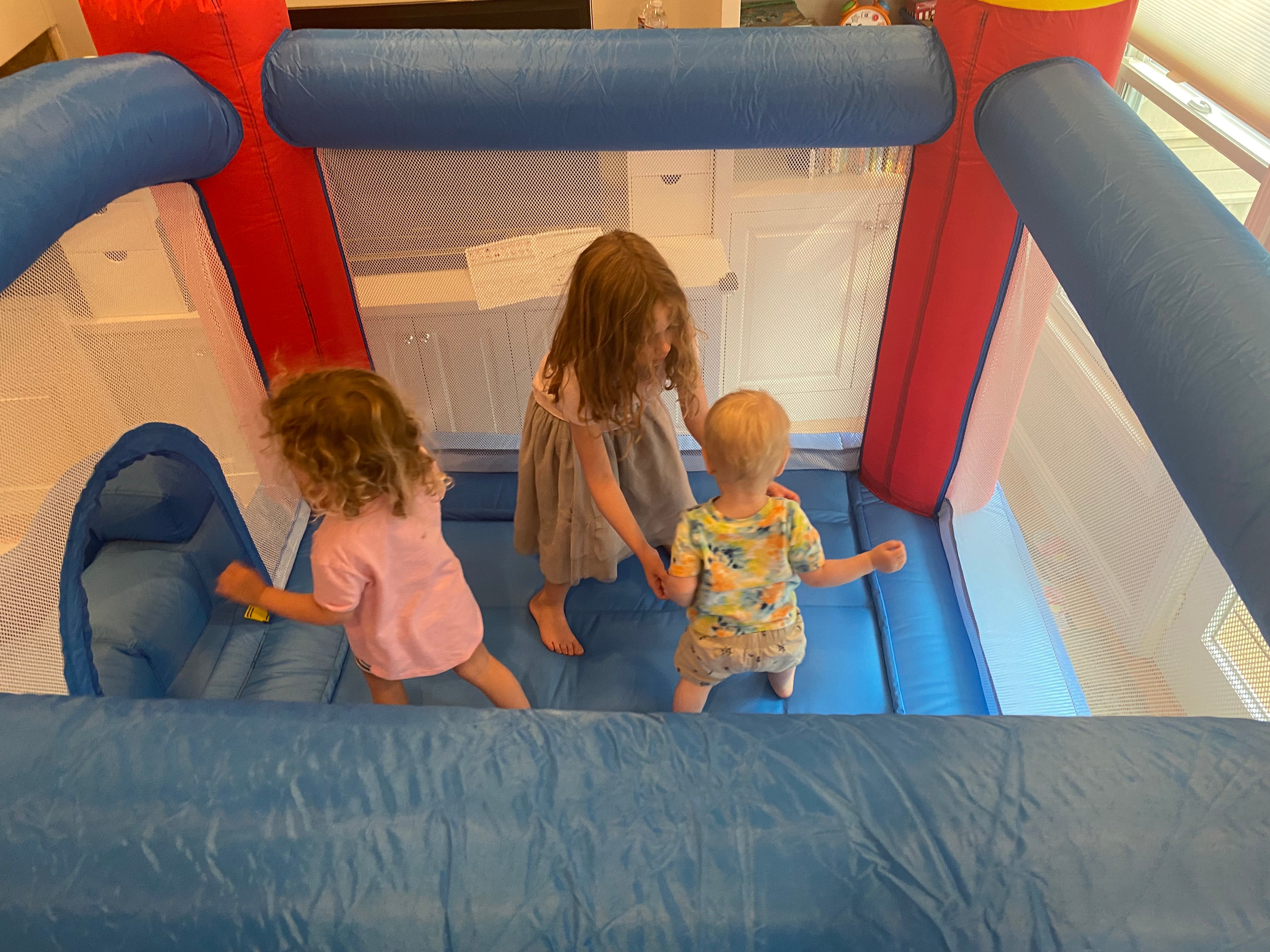
Bounce house in my living room to survive the "bad air" days
The changing climate presents the existential challenge of how long future generations will be able to populate this planet. But for those of us with children, the changing climate also brings a very present-day logistical challenge of securing consistent child care and education through climate crises. What used to be a few snow days is now a myriad of extreme weather events that can strike at any time. In September 2021, “a month of extreme weather has disrupted back-to-school across the country, with closures affecting more than 1.1 million students.”
Extreme weather also exacerbates inequities in our education system in the United States. While some private schools can afford air filters to combat pollution and wildfire smoke, other schools may lack even basic air conditioning and heating systems to make classrooms tolerable for students. These schools without temperature control end up closing when temperatures fall outside a tolerable range. We saw during Covid that the private schools had resources to develop workarounds and remain operating in person while many public schools did not. The same thing happens with climate change.
Not only is child care and education at risk, but the changing climate itself is impacting our children’s brain development. According to a new report on wildfire smoke and air pollution, “there’s clear scientific evidence that ozone and particle pollution can cause low birth weight, premature birth, and other reproductive and developmental harm.” We also know when child care and school is closed, even if kids receive the same care and education at home, it’s not the same for their brain development as socializing with other children.
This Earth Day, it’s imperative that we all take steps to mitigate climate change. There’s no time to waste, not because of our hypothetical future generations of children, but because our children today are impacted. If you’re a parent or an educator, here are some great resources for teaching children about climate change and ideas for what you can do to make a difference for our planet today.


