
-1.jpg?height=100&name=Image%20from%20iOS%20(2)-1.jpg)
Winnie
For some children, traditional school environments may not offer the challenge or stimulation they need to thrive. These children may be identified as "gifted" and could benefit from specialized programs or schools designed to support their unique abilities. In this guide, we’ll explore what gifted education is, how to recognize signs of giftedness early, and how gifted programs and schools can provide the right fit for your child.
What Is Gifted Education?
Gifted education refers to specialized teaching methods, programs, and support services for students who demonstrate exceptional ability in one or more areas—whether that’s academic achievement, creativity, leadership, or the arts. These children often learn quickly, think deeply, and exhibit unusual problem-solving skills.
Giftedness isn’t defined by a single test score or trait; it's a complex blend of cognitive, social, and emotional characteristics that requires thoughtful recognition and support. A child may be gifted in one area and challenged in another, sometimes known as twice exceptional.
At What Age Can You Identify a Gifted Child?
Giftedness can be identified in children as early as toddlerhood. Pediatricians, early childhood educators, and psychologists can help assess early signs through observation and screening tools.
While formal gifted and talented programs typically don’t begin until school age, understanding and supporting early signs of giftedness can lay a strong foundation for a child’s development.
Early Signs of Giftedness
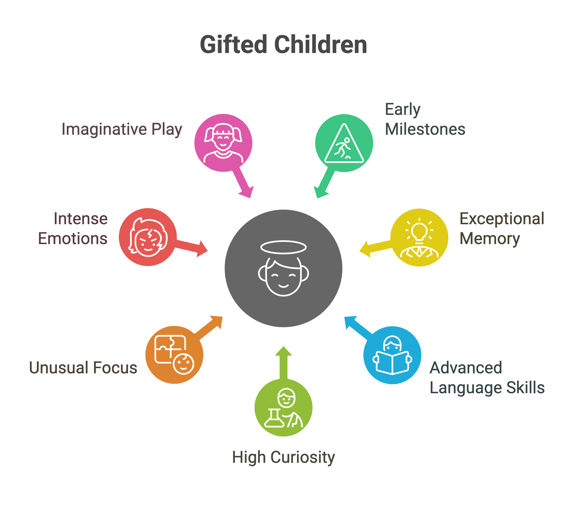
Some traits to look for in infants, toddlers, and preschoolers include:
-
Early milestones: Rolling over, sitting up, walking, talking, or reading earlier than average.
-
Exceptional memory: Remembering places, routines, or names after limited exposure.
-
Advanced language skills: Speaking in full sentences earlier than peers or having a large vocabulary.
-
High curiosity: Constant questioning, exploring, or interest in how things work.
-
Unusual focus or attention span: Concentrating on a task for longer than typical for their age.
-
Intense emotions or sensitivity: Strong reactions to sensory input, social dynamics, or emotional situations.
-
Imaginative play: Creating elaborate stories or pretending in complex, creative ways.
How to Nurture Giftedness in Young Children
While there may not be formal gifted programs at this age, you can still support your child’s development with:
- Preschool programs: High-quality preschool programs can play a critical role in nurturing early signs of giftedness—even if they don’t label children as gifted. Look for programs that encourage exploration and creativity, adapt activities to the child’s skill level, and support social-emotional learning alongside academics.
-
Books and materials: Provide access to a wide range of books, puzzles, art supplies, and building toys.
-
Follow their interests: Whether it’s space, bugs, or music, letting them dive deep into what they love fosters learning.
-
Social-emotional development: Gifted kids often feel “different”—help them understand and navigate friendships, frustration, and big emotions.
- Talk to educators: Share observations with your child’s caregivers or preschool teachers—they may be able to tailor learning experiences or recommend further evaluation.
Should You Seek Testing for a Young Child?
Some parents opt for early evaluation if their child seems exceptionally advanced or is struggling socially or emotionally due to asynchronous development (e.g., intellectually far ahead but emotionally age-typical). A developmental pediatrician or child psychologist can offer assessments, though many professionals recommend waiting until age 4 or older for more reliable results.
What Should You Do If You Suspect Your Child Is Gifted?
If you believe your child may be gifted:
-
Observe: Keep a journal of your child's behaviors and learning patterns.
-
Talk to teachers: Teachers can provide insight into how your child compares to peers.
-
Consider testing: A psychologist can administer cognitive assessments (like the WISC) to evaluate IQ and other indicators.
-
Explore enrichment: Look for extracurricular activities, enrichment classes, or early learning opportunities to keep your child engaged.
What Are Gifted & Talented Programs?
Gifted and Talented (G&T) programs are specialized educational tracks within public or private schools that offer an accelerated or enriched curriculum. These programs exist to support children who need more intellectual stimulation than what the standard curriculum offers.
G&T programs vary widely by district and school, but may include:
-
Advanced coursework
-
Independent study opportunities
-
Pull-out programs for certain subjects
-
Social-emotional support for gifted learners
Why Are These Programs Important?
Gifted students can become bored or disengaged in traditional classrooms, which may lead to underachievement or behavioral issues. G&T programs help:
-
Keep students intellectually challenged
-
Foster creativity and problem-solving
-
Support peer relationships with like-minded students
-
Promote academic and personal growth
A Brief History of Gifted Education in Public Schools
Gifted education in the U.S. has its roots in the early 20th century, with increasing federal support after the 1950s space race highlighted the need to nurture high-achieving minds. Programs gained traction in the 1970s with the creation of formal guidelines and increased funding. However, access and equity have remained ongoing challenges.
How Do Gifted and Talented Programs Work?
Programs may be part-time (pull-out or enrichment classes) or full-time (accelerated or self-contained classrooms). Curriculum typically includes:
-
Deeper study in core subjects
-
Project-based learning
-
Opportunities for independent research
-
Cross-grade or accelerated learning paths
How Are Children Identified for These Programs?
Identification often includes a mix of:
-
Cognitive ability tests (e.g., IQ)
-
Academic achievement scores
-
Teacher or parent recommendations
-
Classroom performance
-
Portfolio assessments
Eligibility criteria can vary significantly between districts and states, and some programs aim to broaden access by considering multiple forms of giftedness and using equity-based identification methods.
Common Misconceptions About Gifted and Talented Programs
-
Gifted = high achiever: Not all gifted kids are top students; some may struggle with motivation or attention.
-
Gifted kids don't need help: Without proper support, gifted students may experience anxiety, perfectionism, or social issues.
-
Giftedness only shows up in academics: Creativity, leadership, and the arts are also domains of giftedness.
-
Testing is the only way to identify: Observation, teacher input, and work samples are just as important.
What Are Gifted Schools?
Gifted schools are educational institutions specifically designed for gifted learners. They offer full-time, immersive environments with tailored curriculum and resources.
Gifted schools can be both public and private. Public gifted schools include magnet or charter schools with selective admissions (e.g., based on testing). Private gifted schools are independent schools with a focus on gifted education, often with tuition costs and scholarship opportunities.
Gifted Schools vs. Traditional Schools: Key Differences
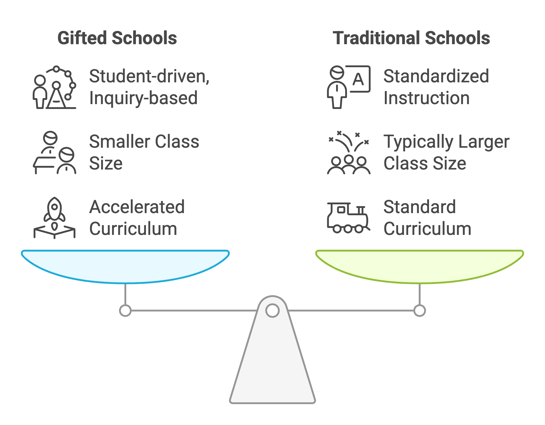
Gifted schools offer an accelerated, enriched, and often interdisciplinary curriculum designed to challenge advanced learners. The teaching style is typically student-driven and inquiry-based, allowing students to explore subjects in greater depth and at a faster pace than traditional classrooms. Class sizes in gifted schools are often smaller, which enables more individualized attention and support. Students are typically surrounded by intellectual and social peers, which can foster a strong sense of community and belonging among gifted learners.
In contrast, traditional schools follow a standard grade-level curriculum aimed at meeting the needs of a wide range of learners. Instruction tends to be more standardized, with less flexibility to adjust pace or depth based on individual student interests or abilities. Class sizes can vary but are usually larger, and students are grouped in mixed-ability classrooms. While many traditional schools offer differentiated instruction, they may not have the resources or programming specifically designed to fully support gifted students.
Who Is Eligible for Gifted Schools?
Eligibility criteria may include:
-
Standardized test scores
-
IQ assessments
-
Portfolios or interviews
-
Teacher recommendations
Some schools also prioritize diversity and use alternative metrics to identify underserved gifted students.
Gifted & Talented Programs vs. Gifted Schools
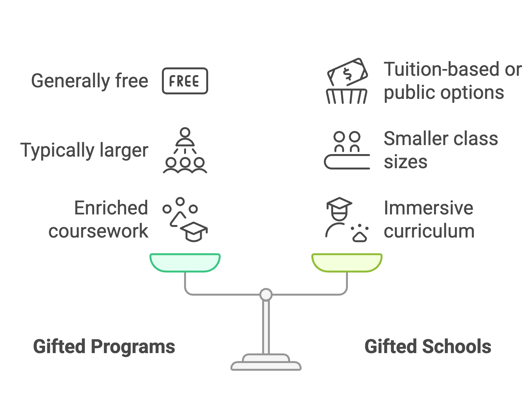
Gifted and Talented (G&T) programs are typically district-specific and operate within public schools. Eligibility for these programs often depends on standardized testing, teacher recommendations, and other district-defined criteria. These programs provide advanced or enriched coursework, but students remain part of the larger school community. Class sizes in G&T programs tend to be similar to regular classrooms, and since they are usually offered through public schools, they are generally free to attend.
Gifted schools, on the other hand, are specifically designed for gifted learners and have more selective, often more rigorous admissions criteria. These schools offer a fully immersive, gifted-focused curriculum tailored to the needs of advanced students. Class sizes are usually smaller, allowing for more individualized attention and deeper engagement. Some gifted schools are public magnet schools and tuition-free, while others are private and require tuition, though scholarships may be available.
Every gifted child is unique. Some may thrive in a G&T program within their local school, while others may need the full-time challenge of a dedicated gifted school. What matters most is finding the right environment that nurtures their curiosity, supports their development, and helps them reach their potential.
Want to explore gifted programs or schools near you? Use Winnie’s school search to find educational options that meet your child’s needs.


